

Cannabis is often evaluated based on THC and CBD. But this approach doesn’t tell the whole story. Two cannabis flowers with comparable THC or CBD levels can be perceived as completely different—in smell, taste, and aroma. The difference lies in the terpene profile. Terpenes shape the cannabis experience on a level that goes beyond mere active ingredient concentration. Anyone who wants to understand cannabis and its various strains in a nuanced way or classify them systematically should therefore rely on chemical profiles rather than individual values. This article provides a solid foundation for understanding cannabis terpenes, interpreting profiles, and systematically categorizing differences.
The most important facts in brief
- Terpenes are natural compounds produced in the trichomes of cannabis.
- They define a product's smell, taste, and aroma and influence how it is perceived.
- Terpene profiles explain the differences between cannabis products better than THC and CBD levels alone.
- Individual terpenes do not exert their effects in isolation, but rather in interaction with others.
- The modern classification of cannabis is based on chemical profiles (chemovars).
What Are Cannabis Terpenes?
A cannabis terpene is an aromatic compound produced in the cannabis plant that significantly influences its smell, taste, and the perception of its effects. Chemically, terpenes are classified as secondary plant compounds and consist of isoprene units. They are produced in the trichomes—the same structures in which cannabinoids are also produced.
In plants, terpenes perform functions such as:
- Pest Control
- Scent Communication
- Interaction with the Environment
In the context of cannabis, they enable one thing above all else: a clear distinction between products with similar active ingredients.
The Entourage Effect: Why Terpenes Should Not Be Considered in Isolation
The effects of terpenes do not occur in isolation, but rather in combination with cannabinoids and other plant compounds. This interaction is described as the entourage effect.1 This means that the overall effect of a cannabis product is not determined by a single substance, but rather by the interaction of all the compounds it contains.
Important to note2:
- Combinations produce different profiles.
- The same THC levels do not result in the same experiences.
The entourage effect serves as a model for describing these relationships, not as a rule that has been fully clinically validated.
List of Cannabis Terpenes (Overview and Classification)
This overview categorizes the most important cannabis terpenes and individual terpene types according to their aroma profile, typical classification, and function within the overall profile. It provides a quick reference and makes it easier to compare different terpene combinations.
| terpene | Flavor Profile | Typical classification | Occurrence outside of cannabis | Profile Roller |
| Farnese | green, apple-like, fresh | subtle, complementary | Apples, plant waxes | secondary |
| Caryophyllene | spicy, peppery | tart, structured | Pepper, cloves | often dominant |
| Limes | citrusy, fresh | perceived as clear and energizing | Citrus fruits | often lead terpenes |
| Humulene | earthy, woody | dry, bitter | hops | balancing |
| Myrcene | earthy, musky | heavy, full | Mango, Thyme | often dominant |
| Nerolidol | woody, floral | soft, calm | Neroli, Ginger | Background |
| Linalool | floral, lavender-like | soft, floral | Lavender | balancing |
| Camphene | fresh, camphor-like | cool, clear | Conifers | secondary |
| Terpinolene | herbal, floral, complex | versatile | Herbs, juniper | rarely dominant |
The Most Important Cannabis Terpenes in Context
Farnese
Farnesene primarily complements fresh, fruity profiles and is rarely the dominant compound. It is often measured alongside myrcene or terpinolene and primarily alters the sensory perception.
Click here for the article: Farnesene Explained – Terpenes, Effects, and Classification in Cannabis
Caryophyllene
Caryophyllene imparts a spicy, peppery aroma and is commonly found in complex cannabis profiles. It is one of the terpenes that also interact with the body's own receptors.
Click here for the article: The Special Terpene Caryophyllene Explained in Simple Terms
Limes
Limonene produces a crisp citrus aroma and is often associated with energizing profiles. It is frequently found in light, fresh terpene blends.
Click here for the article: The Limonene Terpene—All Its Properties and Classification in Cannabis
Humulene
Humulen adds earthy, dry notes and reduces sweetness. It is often found in combination with caryophyllene.
Click here for the article: Properties and Classification of the Terpene Humulene in the Context of Cannabis
Myrcene
Myrcene is one of the most common terpenes found in cannabis flowers and strains. It produces rich, heavy aromas and characterizes many classic profiles.
Click here for the article: Myrcene—a terpene explained in simple terms and classified in the cannabis profile
Nerolidol
Nerolidol complements fragrances with woody-floral notes and usually remains in the background.
Click here for the article: The Terpene Nerolidol: Science, Experience, and Applications
Linalool
Linalool adds floral, lavender-like notes and is often found in softer fragrance profiles.
Click here for the article: Linalool, a Cannabis Terpene: A Scientific Explanation and Classification
Camphene
Camphene has fresh, slightly medicinal notes and is usually present in small amounts.
Click here for the article: Everything You Need to Know About the Rare Cannabis Terpene Camphene
Terpinolene
Terpinolene exhibits a complex profile ranging from herbaceous to floral and citrusy, and is rarely the dominant note.
Click here for the article: What is terpinolene, and what effects are attributed to this terpene?
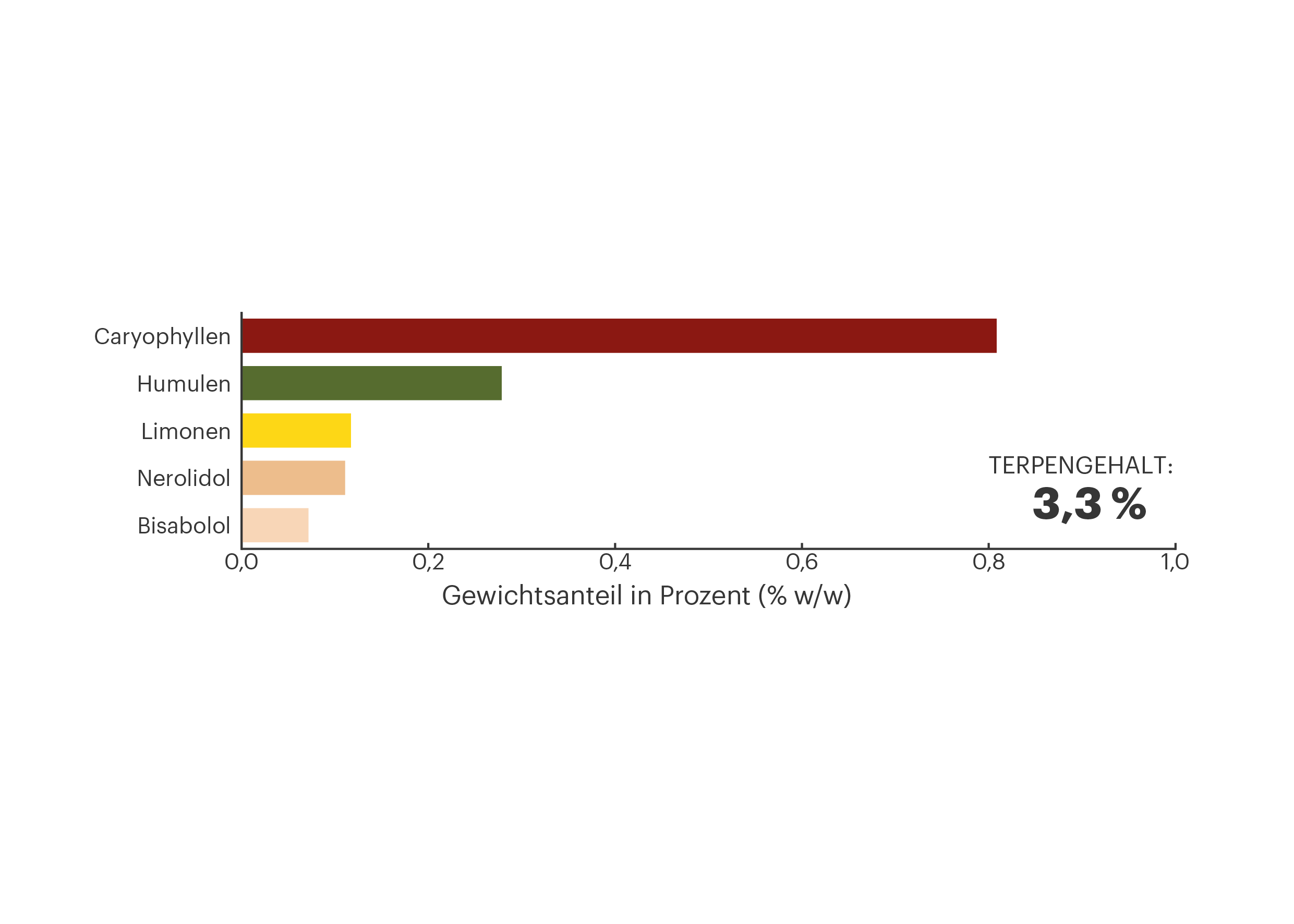
How to Properly Interpret a Terpene Profile
The terpene profile of cannabis flowers consists of several levels:
- Dominant terpenes → shape the first impression
- Secondary terpenes → shape the overall profile
- Trace substances → are measurable but barely perceptible
Classification by total terpene content:
- less than 1% → low-key profile
- 1–2% → clearly noticeable profile
- over 2% → intensive profile
Key point: It's not just the quantity that matters, but the combination of terpenes.
Classify Cannabis by Terpene Profile
Terpene profiles allow for the functional classification of cannabis strains and flowers regardless of their THC or CBD levels.
| Perception | Common Terpene Combinations |
| clear / invigorating | Limonene, Terpinolene |
| calm / soft | Myrcene, Linalool |
| structured / tart | Caryophyllene, Humulene |
This classification does not describe an effect, but rather typical patterns that appear in many profiles.
Terpenes vs. Cannabinoids
Terpenes and cannabinoids are often considered together, but they serve different functions within the cannabis plant and in its use.
Cannabinoids such as THC or CBD interact directly with the endocannabinoid system.3 They bind to specific receptors and trigger measurable physiological effects.
Terpenes work on a different level.4 They influence the overall profile indirectly—for example, through sensory perception, interactions with other biological systems, or by modulating existing effects.
| Category | terpenes | Cannabinoids |
| Primary Role | Aroma, Modulation | direct effect |
| Interaction | indirect, versatile | specifically via receptors |
| Perception | sensory | physiological |
| Variability | very high (100+) | limited |
While cannabinoids define the foundation of a cannabis product, terpenes determine its perceived aroma and the differences between strains.
Two products with the same THC content may be perceived differently if their terpene profiles differ.
In addition, terpenes influence5:
- Inclusion of Certain Substances
- Speed at which effects begin
- Subjective Assessment of the Effect
Storage, Temperature, and Stability
Terpenes are volatile and sensitive to external factors:
- Heat → accelerates evaporation
- Oxygen → causes oxidation
- Light → accelerates degradation
Practice:
- Longer storage reduces flavor intensity
- High temperatures alter the profile
- Open storage leads to losses
Evaporation (Approximate Values):
- Myrcene → approx. 166 °C
- Limes → approx. 176 °C
- Linalool → approx. 198 °C
This means that the same cannabis flowers or strains can undergo significant sensory changes—even without a change in THC content.
Clinical Evidence: What Is Known and What Is Not
Well documented:
- Terpenes as Plant Compounds
- Role as flavor components
- Role in Essential Oils
Not clearly documented:
- The isolated effects of individual terpenes in humans
- Specific Effects of Inhalation
Many statements are based on:
- Preclinical studies
- Empirical values
- Transfers from other plants6
A clear distinction is therefore drawn between description and verifiable effect.
Chemovars Instead of Indica and Sativa
The traditional distinction between Indica and Sativa is becoming less important. Instead, classification is increasingly based on chemovars —that is, on a product’s chemical profile, which consists of cannabinoids and terpenes.
This model allows you to:
- More Detailed Description
- Greater comparability
- Reproducible Classification
Conclusion
Cannabis terpenes provide the basis for distinguishing between strains, flowers, and profiles. They explain why two products with comparable THC content smell, taste, and are perceived differently. As a result, the classification of cannabis is shifting away from simplified categories toward chemical profiles consisting of cannabinoids and terpenes.
In a medical context, this understanding allows for a more nuanced view of cannabis products.7 Instead of focusing exclusively on individual active ingredients, complete profiles are used to better assess tolerability, usage, and individual responses.
At the same time, when dealing with terpenes, it is essential to clearly distinguish between verifiable findings and plausible assumptions. Many of the effects under discussion are based on preclinical research. In many areas, there is still no clear data available regarding their use in humans.
Modern analytical methods make it possible to quantitatively measure terpene profiles and compare them with one another. This allows differences to be not only identified but also objectively described. Anyone who wants to gain a thorough understanding of cannabis works with profiles. Terpenes provide the structure, cannabinoids the foundation—and it is only through their interaction that a consistent overall picture emerges.
FAQ
Myrcene, limonene, and caryophyllene are commonly found in many cannabis profiles.
More than 100 different terpenes are known, but only some of them occur regularly in significant amounts.
The smell and aroma of a cannabis strain result from a combination of various terpenes. Even slight differences in their ratios can significantly alter the overall profile. Two products with identical THC content can therefore smell and be perceived in completely different ways.
How do terpenes affect the effects of cannabis?
Terpenes do not directly influence the pharmacological effects, but rather alter perception through their interaction within the overall profile.
The entourage effect describes the interaction between cannabinoids, terpenes, and other plant compounds.
- Russo EB. Taming THC: The Potential Synergy of Cannabis and the Phytocannabinoid-Terpenoid Entourage Effects. British Journal of Pharmacology. 2011. ↩︎
- Russo EB. Cannabis synergy and phytocannabinoid-terpenoid interactions. British Journal of Pharmacology. 2011. ↩︎
- Pertwee RG. The pharmacology of cannabinoid receptors. British Journal of Pharmacology. 2006. ↩︎
- Booth JK et al. Terpene synthases from Cannabis sativa. Plant Physiology. 2017. ↩︎
- Santiago M et al. Terpenes Modulate Cannabinoid Receptor Signaling. Scientific Reports. 2019. ↩︎
- Noma Y. Structure and biosynthesis of terpenoids. Bioscience Biotechnology and Biochemistry. 2012. ↩︎
- LaVigne JE et al. Cannabinoid-terpene interactions. Frontiers in Pharmacology. 2021. ↩︎