

Multiple sclerosis is one of the most common neurological disorders affecting young adults.1 After receiving a diagnosis, many people ask themselves a key question: Is multiple sclerosis curable? The short answer is: No, multiple sclerosis is not currently curable.2
The good news, however, is that treatment for the disease has improved significantly in recent decades. Modern therapies can slow the progression of the disease, reduce flare-ups, and enable many patients to lead relatively normal lives. In addition, medical researchers are working intensively on new approaches that could even activate repair mechanisms in the nervous system in the future.
What is multiple sclerosis? Key facts at a glance
Multiple sclerosis (MS) is a chronic disease of the central nervous system. It affects the brain and spinal cord. In this disease, the immune system mistakenly attacks the body’s own tissues.3 The myelin sheaths are particularly affected. These protect the nerve fibers and ensure that electrical signals are transmitted quickly throughout the nervous system. When the myelin is damaged, inflammation and so-called lesions develop in the brain or spinal cord.4 As a result, signals between nerve cells may be transmitted more slowly or not at all. The consequences vary widely. Some people experience only mild symptoms. Others develop more severe neurological symptoms over time.
Is multiple sclerosis curable?
To date, there is no treatment that can completely eliminate the cause of the disease. Nevertheless, treatment has improved significantly in recent years.5 Modern medications and alternative treatment methods can:
- Reduce disease activity
- Prevent new flare-ups
- Slow the progression of the disability
As a result, many patients experience significantly fewer flare-ups and are able to manage their daily lives independently for a long time.
Treatment therefore focuses on three goals: controlling inflammation, alleviating symptoms, and improving quality of life.
Causes of Multiple Sclerosis
The exact causes of the disease have not yet been fully determined. Experts believe that several factors are involved.6
Autoimmune reaction
The main mechanism is an abnormal immune response. In this process, immune cells attack the myelin in the nervous system.
Genetic factors
Multiple sclerosis is not directly hereditary. However, genetic factors can play a role. People with affected family members have a slightly higher risk.
Environmental factors
External factors can also contribute to its development. These include, for example:7
- Vitamin D deficiency
- Certain viral infections, such as the Epstein-Barr virus (EBV) or human herpesvirus 6 (HHV-6)
- Smoking
- Lifestyle factors
The disease is likely caused by a combination of these factors.
Symptoms of multiple sclerosis
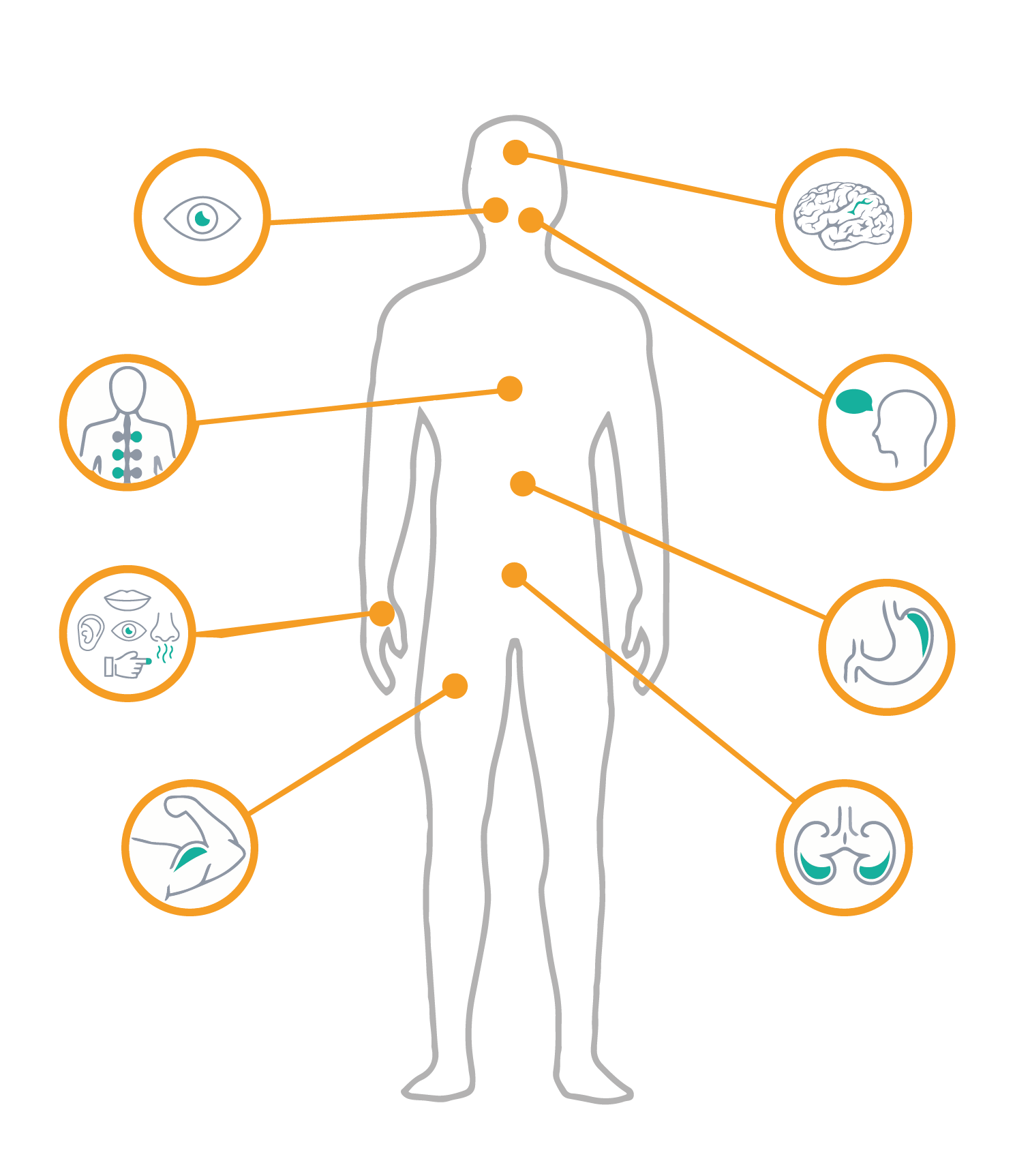
The symptoms of the disease vary widely. They depend on which parts of the nervous system are affected. Typical symptoms include:
- Vision problems
- Numbness
- Tingling in the arms or legs
- Balance disorders
- Muscle weakness
- Severe fatigue
- Difficulty concentrating
A well-known neurological sign is Lhermitte's sign. In this case, patients feel an electric shock-like sensation along the spine when they bend their head. Many patients also experience so-called relapses. During these episodes, symptoms suddenly worsen and persist for several days or weeks. A common form of the disease is relapsing-remitting multiple sclerosis (RRMS). In this form, phases with symptoms alternate with phases of recovery.
How is multiple sclerosis diagnosed?
The diagnosis is usually made by a neurologist. Several tests are used in combination. The most important diagnostic procedures include:
MRI (Magnetic Resonance Imaging)
This imaging technique can reveal typical areas of inflammation in the brain and spinal cord.
Cerebrospinal fluid analysis
During the procedure, cerebrospinal fluid is drawn from the spinal cord. Certain inflammatory markers can provide clues about the condition.
Neurological tests
In addition, reflexes, movements, and sensation are examined.
Early diagnosis is important. It allows for timely treatment and can have a positive impact on the course of the disease.
How is multiple sclerosis treated?
The treatment consists of various forms of therapy.
Disease-modifying therapy
These medications affect the immune system. The goal is to reduce inflammation and prevent further damage to the nervous system. Examples of modern MS medications include:
- Interferons
- Natalizumab
- Ocrelizumab
- Fingolimod
They are part of what is known as disease-modifying therapy.
Treatment of Relapses
Acute flare-ups are often treated with corticosteroids. These medications can quickly reduce inflammation in the nervous system.
Symptomatic treatments
Many symptoms can be treated specifically. These include, for example:
- Pain Management
- Physical Therapy
- Treatment of Muscle Spasticity
- Support for fatigue
Rehabilitation can also help maintain mobility and independence.
Supportive measures to improve quality of life
In addition to medical treatments, other measures can make daily life with the condition easier.
Diet and Lifestyle
No special diet can cure multiple sclerosis. However, a balanced diet supports overall health. Experts recommend a low-inflammatory diet that includes:
- Plenty of fruits and vegetables
- Healthy Fats
- Foods that are minimally processed
In addition, regular exercise is an important factor. Regular physical activity can strengthen muscles, reduce fatigue, and improve overall well-being.
Medical cannabis
In recent years, medical cannabis has also been studied as a potential adjunctive treatment. Several studies show that cannabinoids can alleviate certain symptoms.
A large Cochrane review of 25 randomized trials involving approximately 3,700 patients found evidence that cannabis products may reduce muscle spasticity in MS.8
A meta-analysis of 17 studies involving over 3,000 patients also showed small but significant improvements in neuropathic pain.9
Positive effects have also been observed in cases of bladder problems. In a clinical study involving 135 patients, a THC/CBD oral spray reduced the frequency of urination and nighttime trips to the bathroom.10
Another study involving over 600 participants showed a reduction in incontinence episodes of approximately 33 to 38 percent among those treated with cannabinoids, compared with about 18 percent among those receiving a placebo.11
However, it is important to note that medical cannabis can alleviate symptoms but does not treat the underlying cause of the condition.
Life expectancy in multiple sclerosis
Studies show that life expectancy for people with MS is now only slightly reduced. On average, it is about 5 to 10 years lower than that of the general population.12 However, many people with MS live to a ripe old age. The prognosis depends heavily on various factors:
- Form of the disease
- Early diagnosis
- Consistent treatment
- General Health
An active lifestyle and good medical care can have a positive impact on the course of the disease.
Will MS ever be curable? New research
Researchers are working intensively on new treatments. One particularly promising approach is known as remyelination.13 This involves repairing damaged myelin sheaths in the nervous system. Scientists are investigating, for example, mechanisms that influence the maturation of oligodendrocytes. These cells can form new layers of myelin.14 If such repair processes can be specifically activated, this could enable a completely new form of treatment in the future. Stem cell therapies and new immunotherapies are also currently being researched.
Conclusion
Multiple sclerosis is currently incurable. It remains a chronic neurological disease. Nevertheless, modern therapies have significantly improved treatment. Medications can control inflammation, reduce relapses, and slow the progression of the disease. Supportive measures such as exercise, rehabilitation, and medical cannabis can also help alleviate symptoms and improve quality of life. There are several ways to obtain a prescription. This in-depth article describes the exact process and the requirements: Becoming a Cannabis Patient
Medical researchers continue to work intensively on new treatments. In particular, approaches aimed at repairing the nervous system could lead to significant advances in the future.
FAQ
No. The disease is currently considered chronic and incurable. However, appropriate treatment can significantly influence the course of multiple sclerosis. Today, many patients are able to live with the disease in a relatively stable condition for many years if treatment is started early.
After receiving a diagnosis, many people wonder whether the disease is life-threatening. The good news is that multiple sclerosis is rarely directly fatal. In most cases, patients do not die from the disease itself, but from related conditions or complications. Thanks to modern treatments and improved medical care, the prognosis has improved significantly in recent decades.
Modern medicine focuses on reducing inflammation and preventing further damage to the nervous system. The goal of any treatment is to stabilize the course of multiple sclerosis and improve patients’ quality of life in the long term.
Many people with multiple sclerosis lead active lives for many years. Early treatment, regular medical care, and communication with other patients or support organizations such as the DMSG—which can be contacted at any time—are crucial.
An important resource is the DMSG (German Multiple Sclerosis Society). There, patients and their families can obtain information about multiple sclerosis, appropriate treatments, and counseling services. Through the DMSG website, you can also contact regional counseling centers directly.
- Reich DS, Lucchinetti CF, Calabresi PA. Multiple Sclerosis. New England Journal of Medicine. 2018. ↩︎
- Thompson AJ et al. Multiple sclerosis. The Lancet. 2018. ↩︎
- Reich DS, Lucchinetti CF, Calabresi PA. Multiple Sclerosis. NEJM 2018. ↩︎
- Filippi M et al. Multiple sclerosis. Nature Reviews Disease Primers. 2018. ↩︎
- Kuutti K et al. Mortality and causes of death among people with multiple sclerosis. ↩︎
- Olsson T, Barcellos LF, Alfredsson L. Interactions between genetic, lifestyle, and environmental risk factors for multiple sclerosis. Nature Reviews Neurology. 2017. ↩︎
- Bjornevik K et al. Longitudinal analysis reveals a high prevalence of Epstein–Barr virus associated with multiple sclerosis. Science / Nature Reviews Neurology. ↩︎
- Cochrane Review: Cannabis and Cannabinoids for Symptomatic Treatment in People with Multiple Sclerosis. ↩︎
- Torres-Moreno MC et al. Assessment of the efficacy and tolerability of medicinal cannabinoids in patients with multiple sclerosis. 2018. ↩︎
- Kavia R et al. Randomized controlled trial of Sativex for the treatment of detrusor overactivity in multiple sclerosis. 2010. ↩︎
- Freeman RM et al. The effect of cannabis on urge incontinence in patients with multiple sclerosis. 2006. ↩︎
- Zarranz A et al. Mortality and cause of death in multiple sclerosis. ↩︎
- Franklin RJM, Ffrench-Constant C. Remyelination in the CNS: from biology to therapy. Nature Reviews Neuroscience. ↩︎
- Franklin RJM, Goldman SA. Glial Disease and Repair – Remyelination. Nature Reviews Neuroscience. ↩︎