

What is medicinal cannabis? This question occupies researchers, doctors, patients and society alike. In the early 1990s, scientists discovered the body's own endocannabinoid system. Since then, research into cannabis has experienced a new upswing.
In March 2017, the "Cannabis as Medicine" law came into force in Germany. Since then, doctors have been allowed to prescribe cannabis-based medicines. These are only available from pharmacies, where their quality is strictly controlled, as cannabis is classified as a prescription-only medicine.
The most important facts in brief
- Medicinal cannabis is a medicine made from the hemp plant.
- It works via the body's own endocannabinoid system.
- The most important cannabinoids are THC and CBD.
- It has been available on prescription in Germany since 2017.
- They are sold exclusively through pharmacies.
Historical background of medicinal cannabis
The hemp plant has accompanied mankind for thousands of years. People made ropes, fabrics and paper from the fibers. The flowers were used in ancient times and in traditional Chinese medicine. Cannabis came to Europe in the 19th century. Queen Victoria took it for menstrual cramps, Empress Elisabeth of Austria for coughs.1 Until the early 20th century, cannabis tinctures were available in almost every pharmacy. Then came a change. In 1961, the UN Single Convention declared cannabis a drug.2 Possession and medical use were banned. It was not until 2017 that cannabis was given the status of a medicinal product again in Germany.
Endocannabinoid system as the basis for medicinal cannabis
The endocannabinoid system (ECS) acts like an internal control system. It influences appetite, mood, sleep and pain perception. The system consists of three parts:
- endocannabinoids, i.e. the body's own messenger substances.
- cannabinoid receptors (CB1 and CB2).
- enzymes that control signal transmission.
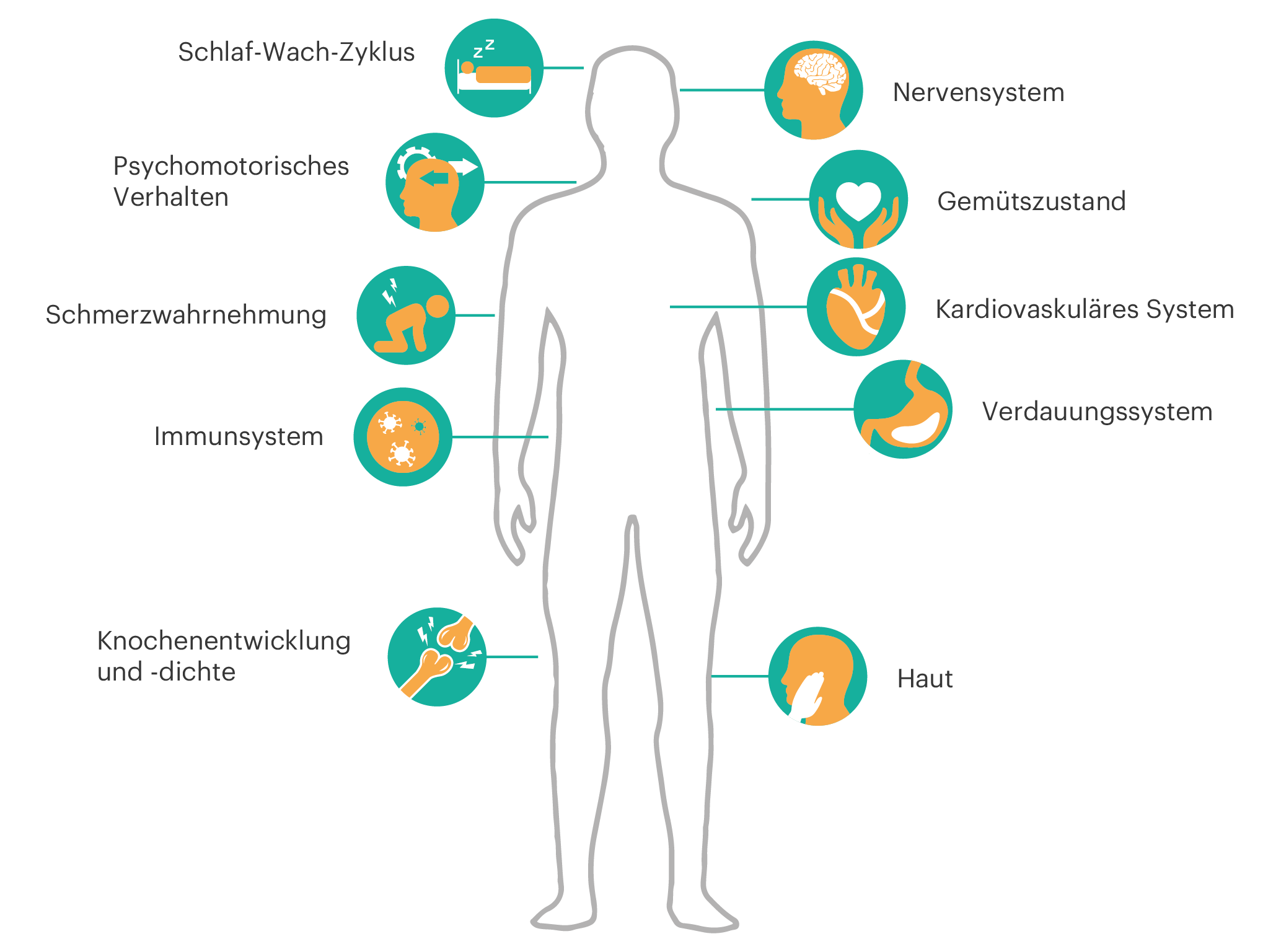
CB1 receptors are mainly found in the brain, the digestive tract and fatty tissue. CB2 receptors are mainly found in immune cells. Plant cannabinoids are similar to the body's own substances. They can bind to the same receptors and thus trigger certain processes in the body. It is precisely this property that makes cannabis interesting as a medicine.3
Cannabinoids in medicinal cannabis
Cannabinoids come in three groups:
- Endocannabinoids, which the body produces itself.
- Phytocannabinoids that come from the plant.
- Synthetic cannabinoids produced in the laboratory.
Plant cannabinoids are particularly important for medicine. The focus is on THC and CBD.
THC - delta-9-tetrahydrocannabinol
THC is the best-known active ingredient in the hemp plant. It is responsible for the psychoactive effect. THC binds to CB1 and CB2 receptors and thus influences numerous bodily functions. In low doses, it can alleviate certain symptoms. In excessive doses, it can be responsible for feelings of tiredness, slight dizziness or inner restlessness.4
CBD - Cannabidiol
CBD works differently. It binds only weakly to the known receptors. It has no intoxicating effect and is therefore considered to be well tolerated. Doctors often use CBD to improve the tolerance of THC - especially at the start of treatment. Every person reacts differently. This is why doctors monitor the effect closely and adjust the dosage.5
| THC | CBD |
| Mainly responsible for the psychoactive effect. | No intoxicating effect. |
| Interacts with CB1 and CB2 receptors. | Only has a limited effect via CB1 and CB2 receptors. |
| Helps to relieve symptoms, e.g. chronic pain, spasticity, and chemotherapy-induced nausea and vomiting. | Can help relieve symptoms of various conditions such as chronic headaches and migraines, chronic abdominal pain, inflammatory bowel disease, stress and anxiety disorders and substance use disorders. |
Forms and dispensing of medicinal cannabis
In Germany, patients can only obtain medicinal cannabis from pharmacies. The preparations are subject to strict controls and are produced in a standardized manner.
Medical cannabis is available in various forms:
- Dried flowers
- Extracts and oils
- Finished medicinal products with defined active ingredient contents
Which form a patient receives is ultimately decided by the doctor. However, the medical issue and the patient's needs play an important role in the decision-making process.
There are two different ways to become a medical cannabis patient: Read more about this here.
Conclusion: What is medicinal cannabis?
The answer to the question "What is medicinal cannabis?" can be summarized as follows: It is a medicine made from the hemp plant, strictly controlled and subject to prescription. Its effect is based on its interaction with the body's endocannabinoid system.
The most important active ingredients are THC and CBD, which differ significantly in their properties. Since the law was amended in 2017, medicinal cannabis has once again become part of medicine in Germany.
For patients, this means that cannabis in pharmacies is no ordinary natural product, but a clearly defined form of medicinal therapy with a long tradition and current scientific significance.
FAQ
Cannabis refers to the hemp plant and its flowers and leaves, which can be used for various purposes. Medicinal cannabis refers to strictly controlled products that are only available on prescription from pharmacies. Until the 2024 reform, cannabis in Germany was fully subject to the German Narcotics Act (BTMG). Only since the law was amended in 2017 have doctors been allowed to prescribe cannabis regularly as a medicinal product as part of medical treatment - previously, this was only possible with an exemption.
A doctor issues a prescription if he or she sees a medical need. The pharmacy then dispenses the flowers or extracts. Close contact between the doctor and the patient is important in order to find the right dosage and form.
The health insurance company can cover the costs if there is a clear medical justification. The application is usually submitted by the attending physician on behalf of the patient. The patient is involved in the process and is in close contact with the doctor and health insurance company during the procedure. For many specialist groups, an application to the health insurance fund is no longer mandatory. However, in order to avoid possible negative consequences, it is recommended to submit an application for cost coverage in case of doubt. Even if the need for care is not an official criterion, it often plays a role in everyday life, as medicinal cannabis is often used for chronic and protracted illnesses. Whether the health insurance company will cover the costs is decided on a case-by-case basis.
Medical cannabis as a medicine can cause mild side effects such as dizziness, tiredness or concentration problems. In some cases, restlessness or anxiety may also occur. The exact reaction depends on the dosage, strain and individual sensitivity. Therefore, every use should be part of a medically supervised therapy.
Yes, but only under certain conditions. Medical cannabis as a medicinal product is still subject to prescription and may only be dispensed by pharmacies. This also includes approved online or mail-order pharmacies. The prerequisite is a valid doctor's prescription, which is uploaded digitally or submitted by post. This is the only way to ensure that dispensing is carried out in accordance with legal requirements and that the quality is checked. Offers outside the pharmacy system are illegal and entail considerable risks.
Cannabis can be used as part of a medical therapy if other treatments are not sufficient. This particularly often concerns pain, such as chronic pain or pain that is difficult to treat. There is more and more scientific information and ongoing research on this. Contact your trusted doctor if you would like more individualized information.
- Fellner, S., & Unterreiner, K. (2013). Morphine, Cannabis and Cocaine: Medicine and Prescriptions of the
Imperial House. Amalthea Signum publishing house. ︎ - Pisanti, S., & Bifulco, M. (2017). Modern history of medical cannabis: from widespread use to
prohibitionism and back. Trends in Pharmacological Sciences, 38(3), 195-198. ︎ - Di Marzo, V., & Piscitelli, F. (2015). The endocannabinoid system and its modulation by
phytocannabinoids. Neurotherapeutics, 12(4), 692-698. ︎ - Lucas, C. J., Galettis, P., & Schneider, J. (2018). The pharmacokinetics and the
pharmacodynamics of cannabinoids. British journal of clinical pharmacology, 84(11),
2477-2482. ︎ - Larsen, C., & Shahinas, J. (2020). Dosage, efficacy and safety of cannabidiol administration in
adults: a systematic review of human trials. Journal of clinical medicine research, 12(3), 129. ︎