
Cannabinoids are, at their core, chemical compounds. One of these compounds, THC, binds to specific receptors in the human body1 (known as cannabinoid receptors). Cannabinoids became widely known primarily through the hemp plant, Cannabis sativa. More than a hundred different cannabinoids are found in this plant, including THC and CBD. Both THC and CBD are being studied for medical applications and are increasingly used in medications.
However, cannabinoids are now found far beyond the medical field—for example, in discussions about the legalization of cannabis in general, dietary supplements, or synthetic substitutes. At the same time, there is often confusion about what cannabinoids actually are, how they work in the body, and how natural and synthetic variants differ.
The most important facts in brief
- Cannabinoids are substances that interact with the body's endocannabinoid system (ECS).
- They occur naturally in the cannabis plant or are produced synthetically.
- THC and CBD are among the best-known cannabinoids.
- THC can cause noticeable psychoactive changes in the body, while CBD is classified in medicine as an anxiolytic, meaning it relieves anxiety.
- Synthetic cannabinoids differ significantly from their natural counterparts and are often associated with health risks.
- The legal situation depends on the specific ingredient and its use.
What are cannabinoids, explained simply?
Cannabinoids are molecules. Among them, THC is the only cannabinoid that binds to so-called cannabinoid receptors in the body. These receptors are part of the endocannabinoid system—a biological network involved, among other things, in signaling processes within the nervous system.
Generally speaking, cannabinoids can be divided into three groups:
| Type | Description |
| Phytocannabinoids | Natural cannabinoids from the cannabis plant |
| Endocannabinoids | Substances produced by the body itself |
| Synthetic cannabinoids | Synthetically produced cannabinoids |
The best-known plant-derived cannabinoids are:
- THC (tetrahydrocannabinol)
- CBD (cannabidiol)
- CBG (cannabigerol)
- CBN (Cannabinol)
These substances differ chemically and affect the body in different ways.
How do cannabinoids work in the body?
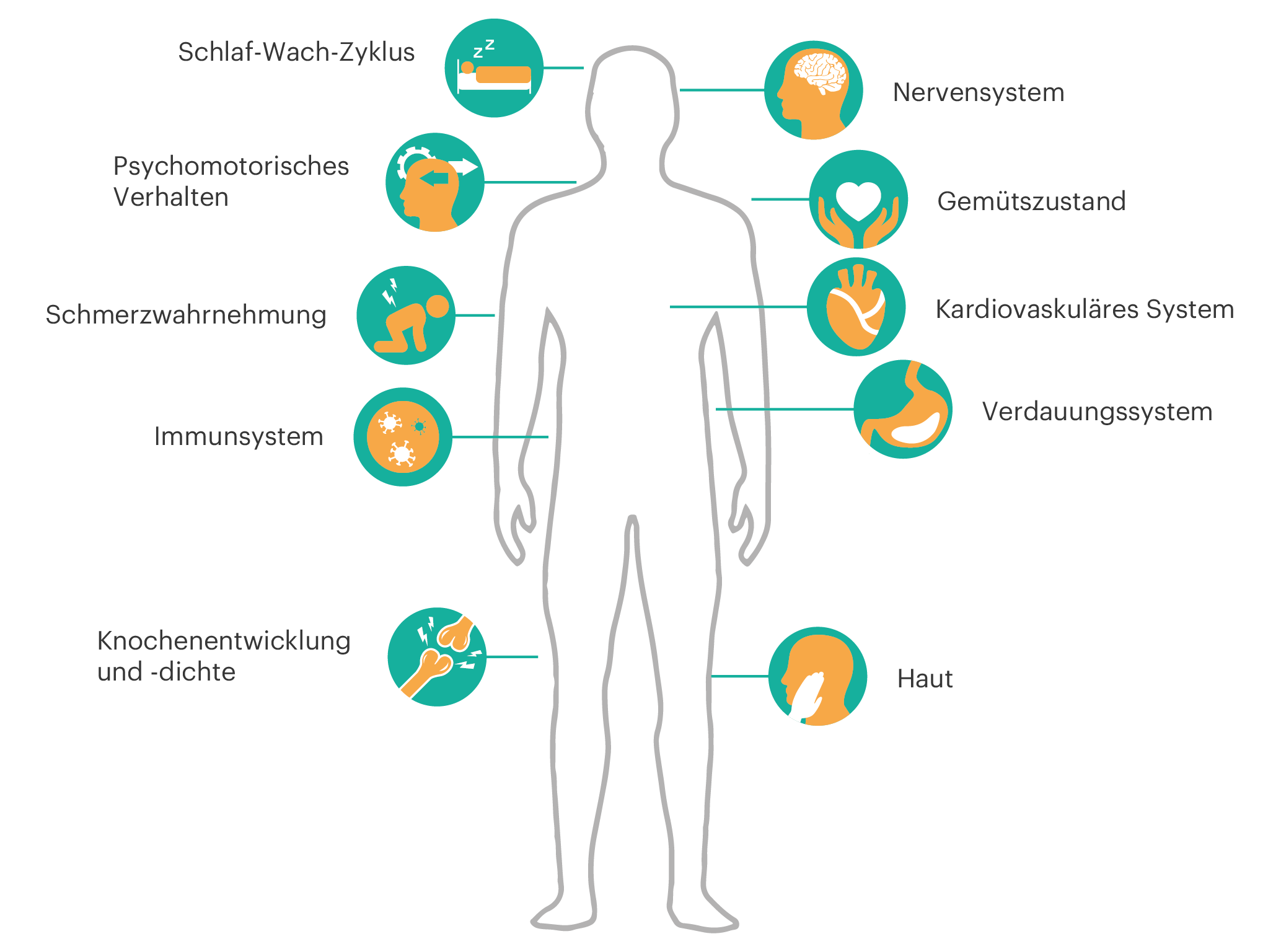
The human body contains specific receptors that respond to cannabinoids. The two most important types are the CB1 and CB2 cannabinoid receptors. CB1 receptors are found primarily in the central nervous system, but are also present in numerous peripheral tissues. CB2 receptors are found mainly on immune system cells and, like CB1 receptors, in various peripheral tissues.
When cannabinoids bind to these receptors, certain signaling pathways between nerve cells and other cells in the body are altered. Which processes are affected depends, among other things, on the specific cannabinoid, the amount, and the individual’s physical condition. THC can bind to both CB1 and CB2 receptors. Its effect on CB1 receptors is associated, among other things, with changes in perception, coordination, and mood. CBD behaves differently: It does not bind to CB1 or CB2 receptors in the same way and influences the endocannabinoid system through other mechanisms. For this reason, CBD is often considered separately from THC.
The Endocannabinoid System Explained in Simple Terms
The endocannabinoid system consists of three key components:
- Receptors
- The body's own endocannabinoids
- Enzymes that break down these substances
The human body produces its own cannabinoid-like substances. These include, among others, anandamide and 2-AG2. These endocannabinoids facilitate signal transmission between cells. The system was not studied in detail until the 1990s. Since then, scientists have been investigating the functions it performs in the body and how external cannabinoids interact with this network3.
What types of cannabinoids are there?
To date, more than 100 cannabinoids have been identified in the cannabis plant4. Many of them occur only in very small amounts.
The Most Well-Known Cannabinoids
| Cannabinoid | properties |
| THC | The main ingredient in medical cannabis products, particularly in pain management |
| CBD | A common minor component in medical cannabis products |
| CBG | Precursor to other cannabinoids |
| CBN | Formed during the breakdown of THC |
In addition to these substances, there are numerous other variants, some of which have only been the subject of scientific study for a few years.
Natural vs. Synthetic Cannabinoids
Natural cannabinoids come from the cannabis plant. Synthetic cannabinoids, on the other hand, are produced in a laboratory. Chemically, synthetic substances can differ significantly from natural cannabinoids. Some were originally developed for research purposes. Others later appeared as ingredients in so-called herbal blends or cannabis substitutes.
Unlike plant-derived cannabinoids, synthetic variants are often difficult to assess, as their composition, purity, and dosage can vary significantly in some cases. While THC acts as a partial agonist at cannabinoid receptors, many synthetic cannabinoids function as full agonists. As a result, they can trigger significantly stronger receptor activation and are associated with a higher risk of adverse effects. In addition, impurities from the chemical synthesis process can further increase health risks.
The Federal Institute for Risk Assessment (BfR), the European Monitoring Center for Drugs and Drug Addiction (EMCDDA), and the World Health Organization (WHO) have highlighted the health risks associated with synthetic cannabinoids. These include, among other things, neurological and cardiovascular complications as well as acute symptoms of poisoning.
THC, CBD, and Others—The Most Important Cannabinoids
THC
The best-known cannabinoid in the cannabis plant is THC. It is responsible for the psychoactive effects associated with cannabis. In medicine, THC is used under certain conditions, such as in the form of standardized medications like flowers and extracts.
CBD
CBD does not cause any intoxicating effects. Nevertheless, it can influence mental processes, for example through its anxiolytic properties. As Dr. Guillermo Moreno-Sanz, scientific director of KHIRON, explains:
"CBD is also psychoactive, as it can have an anxiety-relieving effect, but it does not cause an intoxicating high."
Among other things, the substance is also used in cosmetic products and dietary supplements. The scientific evidence regarding CBD continues to evolve. Since cosmetic products are subject to different quality control guidelines than those used in medical applications, the quality and composition of many products vary.
CBG and CBN
CBG is considered a precursor to other cannabinoids. CBN, on the other hand, is produced when THC breaks down, for example, through aging or oxidation. Both substances are currently the subject of intensive research, but have so far played a much smaller role in the market than THC or CBD.
Cannabinoids in Medicine
Cannabinoids are used therapeutically for a wide variety of conditions. In Germany, doctors and online clinics (telemedicine) have been authorized to prescribe cannabis flowers and cannabis extracts since 2017. Since April 2024, cannabis for medical purposes is no longer classified as a narcotic and can be prescribed via a standard prescription or an e-prescription. This is based on the Medical Cannabis Act.5
The following are primarily used:
- Standardized Cannabis Flowers
- Cannabis extracts
- Isolated cannabinoids such as dronabinol
Cannabis flowers contain the plant's natural cannabinoids in a specific composition. Extracts, on the other hand, are processed using pharmaceutical methods and allow for more precise dosing of individual compounds such as THC or CBD.
A doctor may prescribe medications containing cannabinoids for the following conditions, among others:
- Chronic Pain
- Spasticity in multiple sclerosis
- Nausea and Vomiting Associated with Certain Cancer Treatments
- Sleep Disorders and Anxiety
- Loss of Appetite in Severe Illnesses
A frequently cited review by the U.S. National Academies concluded in 2017 that there is “good evidence” for the use of cannabinoids in the treatment of chronic pain, spasticity, and treatment-induced nausea6.
In Germany, too, the medical significance of cannabis has increased significantly.According to the Federal Institute for Drugs and Medical Devices (BfArM), approximately 201 metric tons of cannabis flowers and cannabis extracts were imported into Germany in 2025 for medical and scientific purposes. This represents nearly a threefold increase in import volume compared to 2024 (approximately 72 metric tons, according to the ABDA).
Treatment is generally supervised by a doctor. The form of administration used depends, among other things, on the clinical presentation, dosage, and individual tolerance. While cannabis flowers are usually inhaled, extracts are often used as oil-based preparations or as a spray.
Side Effects and Risks
In some cases—which, according to Dr. Guillermo Moreno-Sanz, “typically affect fewer than 30% of those involved”—cannabinoids can cause adverse effects. Which effects occur depends on the specific substance, the dosage, and individual factors.
Possible side effects include, among others:
- Dizziness
- Fatigue
- Dry mouth
- Changes in heart rate or blood pressure
Products containing THC can also affect perception and reaction time. Authorities report serious health incidents more frequently in connection with synthetic cannabinoids.
Are cannabinoids legal?
The legal situation varies depending on the cannabinoid and the country. In Germany, different regulations apply to THC-containing products than to CBD products. In addition, there are regulations governing pharmaceuticals, narcotics, and new psychoactive substances. Some synthetic cannabinoids fall under the New Psychoactive Substances Act (NpSG). Some substances are legal, while others are expressly prohibited. Since the legal landscape changes regularly, it is advisable to check the current legal status if you have specific questions.
Conclusion
Cannabinoids have evolved from a niche topic into an integral part of medical, political, and scientific debates. With the partial legalization of cannabis and simplified prescribing procedures for cannabis flowers and extracts, public interest in cannabinoids such as tetrahydrocannabinol (THC) and cannabidiol (CBD) is also growing. At the same time, research in this area continues to advance. The Federal Institute for Drugs and Medical Devices (BfArM) notes that medical cannabis can be used “for serious illnesses” when recognized therapies are insufficient or not an option.
One thing is clear: Knowledge about cannabinoids is growing—as is the number of new products, studies, and medical applications.
FAQ on Cannabinoids
What is the difference between cannabinoids and phytocannabinoids?
Cannabinoids are a group of substances originally named after the cannabis plant. They include plant-derived cannabinoids (phytocannabinoids), endogenous endocannabinoids, and synthetic cannabinoids. Phytocannabinoids are the cannabinoids that occur naturally in the cannabis plant.
Why are tetrahydrocannabinol and cannabidiol often compared?
Tetrahydrocannabinol (THC) has an intoxicating effect, whereas cannabidiol does not. Both are among the best-known cannabinoids in cannabis.
Are there cannabinoids in food?
Yes. Cannabidiol is sometimes used in food products, such as oils or beverages7. These are generally not intended for medical use.
Are synthetic cannabinoids comparable to cannabis?
No. Synthetic cannabinoids are chemically different from natural substances found in cannabis.
- Pertwee RG. The pharmacology of cannabinoid receptors and their ligands: an overview. International Journal of Obesity. 2006. ↩︎
- Di Marzo V et al. Endocannabinoids and their metabolic enzymes. Nature Reviews Neuroscience. 2004. ↩︎
- Mechoulam, R., & Parker, L. A. The endocannabinoid system and the brain. Annual Review of Psychology. 2013. ↩︎
- ElSohly MA et al. Phytochemistry of Cannabis sativa L. Progress in the Chemistry of Organic Natural Products. 2017. ↩︎
- Federal Ministry of Health (BMG). Medical Cannabis Act (MedCanG). 2024. ↩︎
- National Academies of Sciences, Engineering, and Medicine. The Health Effects of Cannabis and Cannabinoids. 2017. ↩︎
- European Food Safety Authority (EFSA). Cannabidiol as a novel food. 2022. ↩︎