
Sleep disorders are among the most common health problems in Germany. Millions of people suffer from problems falling asleep and staying asleep, often caused by stress, shift work, jet lag or medication. If traditional sleeping pills are not effective enough or lead to addiction, medical cannabis can be a useful treatment for sleep disorders.
"Cannabis-based medical products led to significant, sustained improvements in sleep quality - regardless of whether patients suffered from anxiety or chronic pain."
Pain Practice, 2025
Several studies have now shown that cannabinoids - especially THC-containing preparations - can help to sustainably improve sleep quality and general well-being.
The most important facts in brief123
- THC improves sleep and sleep quality. People with sleep disorders fall asleep faster and wake up less often.
- Medical cannabis can be prescribed. The prerequisite is a medical diagnosis and a valid prescription.
- Cannabinoids act via the endocannabinoid system and promote calm, relaxation and deep sleep.
- Side effects are usually mild and temporary.
- Data from long-term studies show stable improvements over at least twelve months.
How cannabis affects sleep
The endocannabinoid system (ECS) plays a major role in the regulation of sleep, pain and mood. It is influenced by endogenous cannabinoids and plant substances such as THC (tetrahydrocannabinol) and CBD (cannabidiol).
THC activates CB1 receptors in the brain, slows down neuronal activity and thus reduces stress and inner restlessness. This makes it easier to fall asleep. CBD supports the natural sleep-wake rhythm and can alleviate accompanying symptoms such as anxiety, but is the second most commonly used treatment.
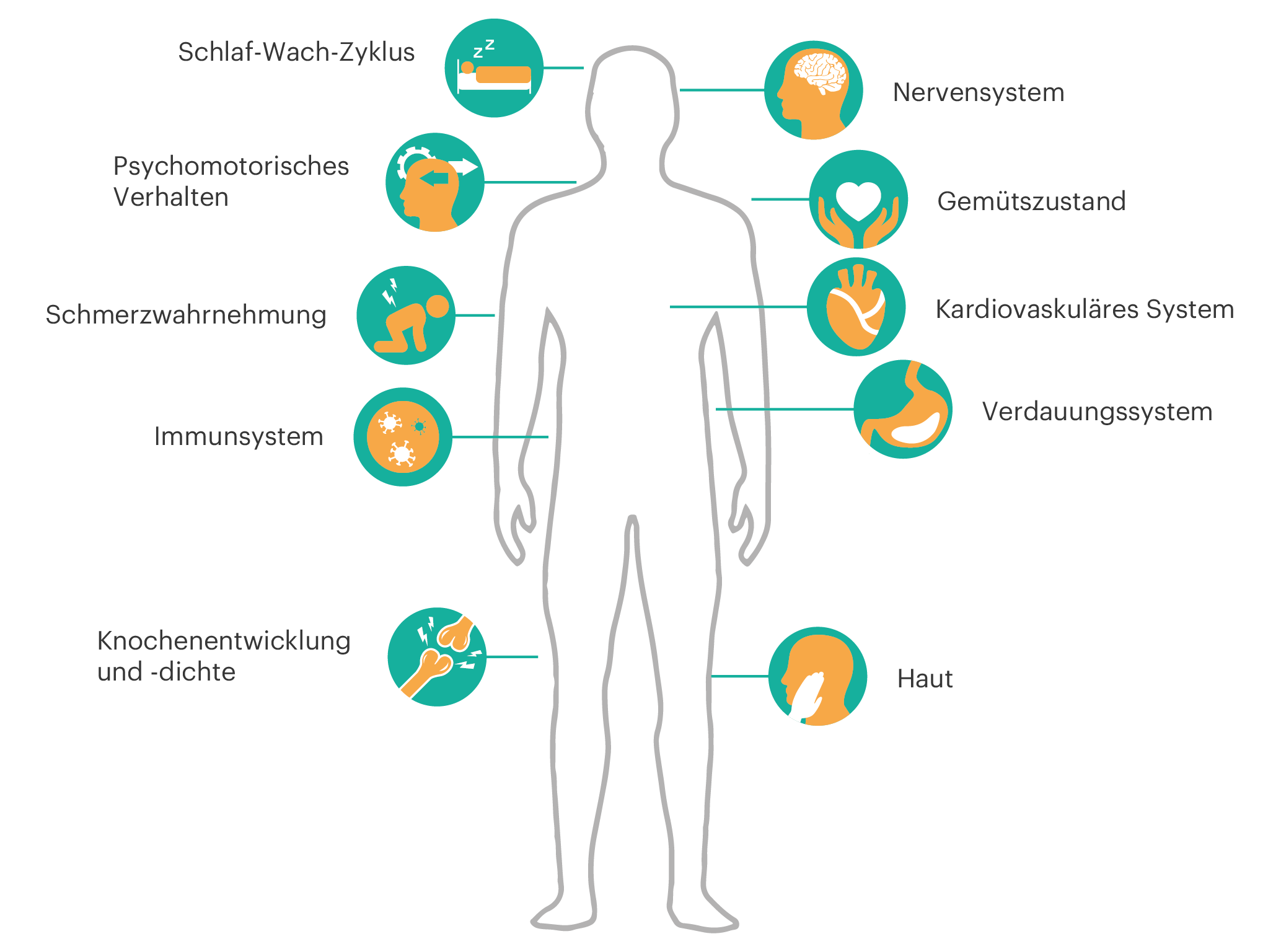
Scientific data shows that treatment with cannabis can increase melatonin levels - a key sleep hormone. This measurable change supports the clinical observation that medicinal cannabis improves sleep not only subjectively, but also biologically.
Studies on cannabis for sleep disorders
Two large registry studies from the UK provide robust data on the efficacy and safety of medical cannabis therapy.
1st study - Anxiety disorders and sleep
Neuropsychopharmacology Reports, 20244
- 302 patients with generalized anxiety disorder were given THC-dominant cannabis for twelve months.
- Die Schlafqualität stieg signifikant (p < 0,001), und die Angstsymptome nahmen deutlich ab.
2nd study - Chronic pain and sleep
Pain Practice, 20255
- 1,212 patients with chronic pain, more than half with sleep disorders, were observed for one year.
- The study participants received individually dosed cannabis-based medicinal products (CBMPs), predominantly THC-dominant flowers, for twelve months.
- Under this medically supervised therapy, there was a significant improvement in sleep quality (SQS + 2.7 points) as a result of cannabis administration.
At the same time, pain and depressive symptoms were reduced - an indication that medicinal cannabis not only improves sleep quality, but also plays an important role in pain therapy.
Summary of results
The results of both studies show that the effects of THC-containing cannabis can be measured both subjectively and objectively and that medicinal cannabis has an overarching effect on several symptoms such as sleep, pain and mood.
Medical cannabis in the treatment of sleep disorders
In medical therapy, cannabis is used in various dosage forms: as oil, standardized extracts or flowers. All preparations are subject to strict quality controls and contain defined quantities of active ingredients. The cannabis flower is the dried flower of the female cannabis plant, which naturally contains high concentrations of cannabinoids (such as THC and CBD) and terpenes. This combination determines both the effect and the individual aroma and taste.
Indica-dominant flowers, such as KHIRON WED 22/1 and KHIRON SCD 25/1, are often prescribed for problems falling asleep. The effect occurs within minutes of inhalation. THC/CBD oils have a slower effect, but are suitable for patients with problems sleeping through the night. CBD oils can be used as a supportive treatment, for example for stress-related sleep disorders.
Treatment and doctor's prescription
Treatment with medicinal cannabis requires medical supervision. Cannabis can be prescribed if traditional sleeping pills, antidepressants or behavioral therapy do not have a sufficient effect.
- A medical diagnosis of a sleep disorder requiring treatment is a prerequisite.
- Since October 2024, an application for cost coverage in accordance with Section 31 (6) SGB V is no longer necessary in all cases. However, an application is recommended if you want to ensure that the statutory health insurance fund will cover the costs.
- Medical cannabis is only dispensed in pharmacies against a valid prescription.
The course of therapy is individually tailored. A low initial dose is usual in order to achieve the optimum effect with minimal side effects.
Would you like to find out more about this topic? Our article Becoming a cannabis patient - 2 ways to get a prescription with instructions provides you with all the important information.
Experiences and effects in everyday life
Many people report that medicinal cannabis helps to calm down and sleep through insomnia. Sleep is described as deeper and more restful, without the side effects of traditional sleeping pills. A patient from Great Britain (UK) described it like this:
"I fall asleep faster and no longer wake up every night. Cannabis has normalized my sleep."
It has also been shown in pain therapy that when pain subsides, sleep automatically improves. Medical cannabis therefore contributes to the holistic treatment of pain and sleep disorders.
Side effects and safety
The documented side effects are mostly mild and temporary:
- Dry mouth
- Dizziness
- Slight tiredness
- Headache
Long-term data show that there is no evidence of dependence or withdrawal when used medically. The effect remains stable even after months. Nevertheless, medically supervised treatment is essential in order to control the dosage individually.
Conclusion
"Cannabis-based medicine led to significant, sustained improvements in sleep quality - regardless of the underlying condition."
Pain Practice, 2025
Cannabis for sleep disorders is an established, scientifically proven therapy. Preparations containing THC have been shown to improve sleep duration, sleep depth and quality of life. The combination of subjective improvement and measurable biological changes - for example in melatonin levels - underlines the medical benefits of this treatment. THC-dominant medicinal flowers such as those from KHIRON are particularly suitable for patients with treatment-resistant sleep problems. Properly dosed and medically supervised, medicinal cannabis is a natural and safe alternative to traditional sleeping pills.
Frequently asked questions (FAQ) about cannabis for sleep disorders
1. how can medicinal cannabis help with sleep disorders?
Medicinal cannabis contains cannabinoids that calm the nervous system and help with sleep disorders. THC in particular promotes sleep, while CBD reduces stress and stabilizes the quality of sleep.
2. are cannabinoids suitable for anyone who sleeps badly?
Not everyone reacts to cannabinoids in the same way. People with sleep problems should seek medical advice before using medicinal cannabis. The right flower variety (ratio of THC and CBD) can help each individual.
3. how do I get in touch with a doctor for medical cannabis?
The first step is to contact a doctor. Ideally, they should already have experience with medicinal cannabis. They can check whether cannabinoids help with sleep and whether a prescription for THC-containing preparations makes sense. CBD-containing preparations are available over the counter in pharmacies and drugstores in Germany.
- Bains M. et al. (2024) - UK Medical Cannabis Registry: An Analysis of Clinical Outcomes in Patients With Generalized Anxiety Disorder Treated With Cannabis-Based Medicinal Products. Neuropsychopharmacology Reports, 44: 129-141 ︎
- Datta P. et al. (2025) - UK Medical Cannabis Registry: A Clinical Outcome Analysis of Medical Cannabis Therapy in Chronic Pain Patients With and Without Co-morbid Sleep Impairment. Pain Practice, 25(1): 44-129 ︎
- § Section 31 (6) SGB V (2024) - Act amending the Fifth Book of the Social Code (SGB V) ︎
- Bains M et al (2024): UK Medical Cannabis Registry: An Analysis of Clinical Outcomes in Patients With Generalized Anxiety Disorder Treated With Cannabis-Based Medicinal Products. Neuropsychopharmacology Reports, 44: 129-141 ︎
- Datta P et al (2025): UK Medical Cannabis Registry: A Clinical Outcome Analysis of Medical Cannabis Therapy in Chronic Pain Patients With and Without Co-morbid Sleep Impairment. Pain Practice, 25(1): 44-129 ︎