
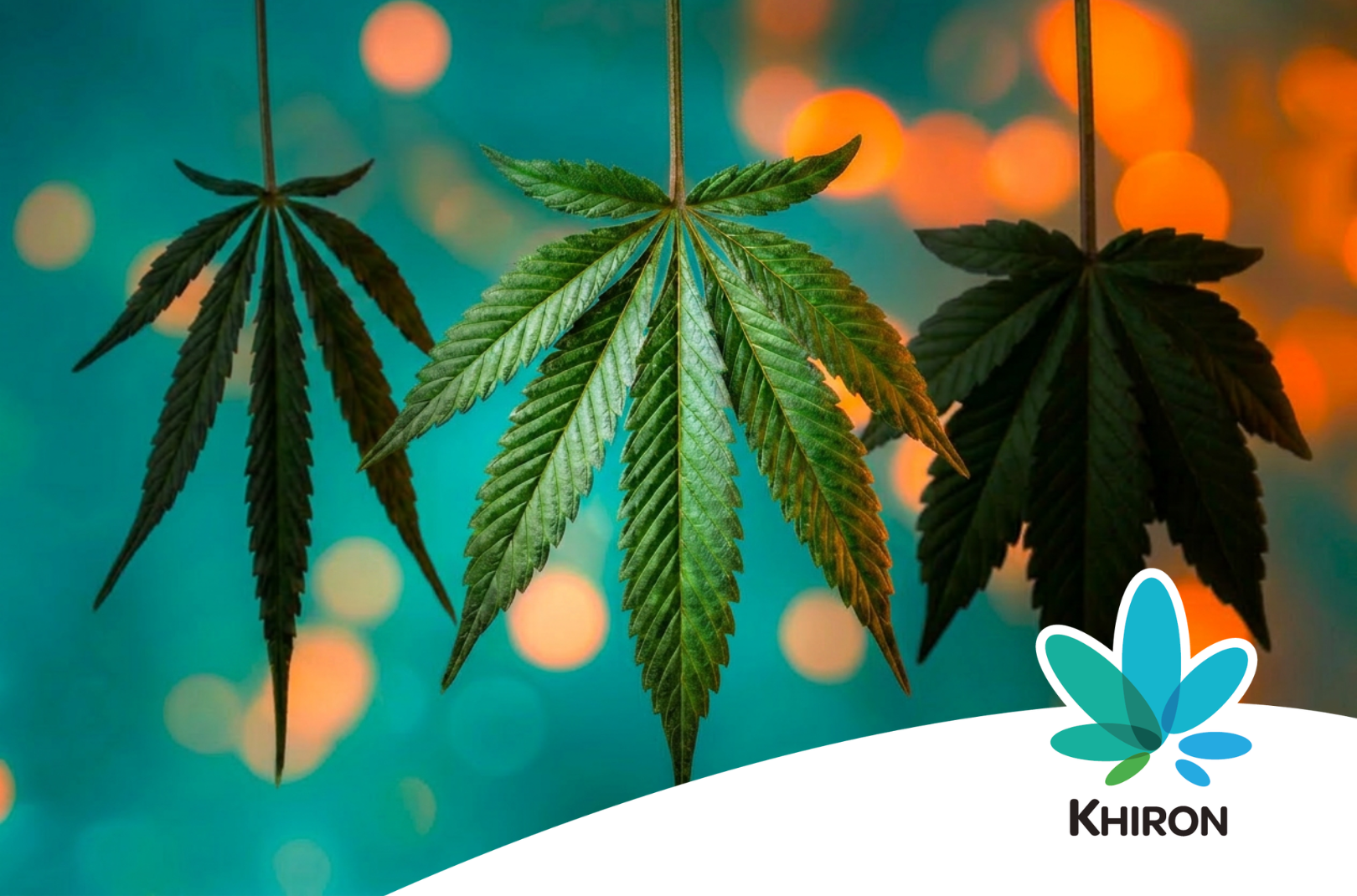
Hardly any modern cannabis strain today is a pure Sativa or Indica line. Instead, hybrids dominate—the result of decades of breeding.1 The goal of these hybrid cannabis breeding programs is to specifically combine certain traits, such as flavor profiles, growth characteristics, or the composition of active compounds.
But what does the term “hybrid” actually mean? How do sativa-dominant and indica-dominant hybrids differ? And why is the classic classification into sativa and indica often no longer sufficient today to reliably describe a strain’s profile? This article explains how hybrid cannabis is created, which factors shape a strain’s characteristics, and why modern breeding approaches are increasingly focusing on a plant’s compounds.
The most important facts in brief
- Hybrid cannabis is created by crossing different cannabis strains.
- Most of the varieties available today are hybrids.
- Pure sativa and indica landraces are now relatively rare.
- There are sativa-dominant, indica-dominant, and balanced hybrids.
- A strain's profile is determined not only by its lineage, but also by its cannabinoids and terpenes.
- Even hybrid varieties with similar origins can differ significantly from one another.
What Is Hybrid Cannabis?
Hybrid cannabis refers to strains that have been created by crossing different cannabis lines. Breeders deliberately combine plants with specific traits to develop new genetics with unique characteristics.
Typical breeding goals include:
- Specific flavor profiles
- Ratio of THC to CBD
- Stable growth characteristics
- High yields
- Short flowering periods
- Flavor Characteristics
Unlike pure Sativa or Indica strains, hybrid strains combine different genetic traits. Depending on their composition, they can have a more energizing, relaxing, or balanced effect.
Thanks to decades of crossbreeding, hybrids now make up the vast majority of all known cannabis strains.
What does “hybrid” mean when it comes to cannabis?
The term “hybrid” originates from plant breeding and refers to the crossbreeding of two different genetic lines. However, this does not automatically mean that a strain consists of equal parts Sativa and Indica. Many hybrids exhibit a distinct tendency toward one particular type. That is why terms like“Sativa-dominant”or“Indica-dominant”have become established. They serve as a rough guide but do not provide an exact description of a strain’s actual profile.2
How are hybrid varieties created, and which ones are among the best known?
Cannabis growers—often referred to as “growers” in English—select plants with desired traits and cross them with one another. The offspring are then further selected over several generations until certain traits become stable.
Some of the best-known hybrid varieties include:
- Blue Dream
- Gelato
- White Widow
- OG Kush
- Gorilla Glue
- Wedding Cake
- Runtz
- Girl Scout Cookies
Modern plant breeding has long since ceased to focus exclusively on a variety’s lineage. The composition of its active ingredients is also becoming increasingly important. Furthermore, many of these genetics exist in different phenotypes and variants.
The characteristics of hybrid cannabis cannot be described in general terms. While lineage and genetic origin provide initial clues, a strain’s profile is actually influenced by numerous factors. These include, among other things, the cannabinoid composition, the terpene profile, and individual differences in perception.
Generally speaking, hybrid varieties are often divided into three categories.
Sativa-dominant hybrid
Sativa-dominant hybrids are traditionally considered to be more energizing. They are often associated with creativity, concentration, and mental stimulation, and are therefore regarded by many users as ideal companions for daytime use. However, these characteristics cannot be predicted based solely on genetic origin. Rather, the decisive factor is the interaction between the cannabinoids and terpenes present in the strain.
Indica-dominant hybrid
Indica-dominant hybrids are traditionally associated with physical relaxation and a more calming effect. Many users prefer these strains in the evening or in quiet settings. However, the same principle applies here: This classification is intended only as a guide. A strain’s actual profile depends on far more factors than just its genetics.
Balanced Hybrids
Balanced hybrids combine characteristics of both strains. They are considered versatile and are often described as neither particularly stimulating nor strongly calming. However, how a strain is ultimately perceived cannot be determined solely by its genetics. In addition to its active ingredients, individual factors also play a key role.
Hybrid Cannabis vs. Sativa vs. Indica
| feature | Sativa | Indica | Hybrid |
| genetics | Traditional Line | Traditional Line | Intersection of Different Lines |
| Typical Characteristics | More energizing | More relaxing | Varies from person to person |
| Dominance | Sativa | Indica | Sativa-dominant, Indica-dominant, or balanced |
| Diversity | Limited | Limited | Very high |
| Significance Today | Rarely pure | Rarely pure | Widespread |
These days, the lines between Sativa, Indica, and hybrids are blurred. Many new strains can no longer be clearly classified into a single category.3 In fact, most well-known strains are based on complex crosses that combine characteristics from different lineage.
Chemovares Continue to Take Center Stage
Today, the traditional classification into Sativa and Indica serves primarily as a rough guide. In research, plant breeding, and medical applications, the focus is increasingly shifting to a strain’s chemical profile. This concept is known as the chemovar model.4
The focus is particularly on the following:
- THC content
- CBD Content
- Composition of Terpenes
This approach allows for a more nuanced description of individual genetic strains than the traditional classification into Sativa and Indica alone. Against this backdrop, the chemovar model is increasingly establishing itself as an important approach in research and in medical cannabis applications.
Cannabinoids and terpenes determine a strain's profile
The profile of a cannabis plant is shaped by the interaction of numerous compounds.5 Cannabinoids such as THC and CBD, as well as the terpenes present, are particularly important in this regard. Terpenes are natural aromatic compounds that play a key role in a plant’s smell and taste.6 They are found not only in cannabis but also in numerous other plants. Among the best-known examples are myrcene, limonene, caryophyllene, and pinene. Since each strain has a unique composition, its aroma, flavor, and chemical profile can vary significantly. This interaction between different compounds is often referred to as the entourage effect.7
If you'd like to learn more about the most important terpenes and their properties, you'll find further information in the corresponding overview article: An Overview of the Most Important Cannabis Terpenes and Their Properties
Why Two Hybrid Varieties Can Differ Significantly
A similar lineage does not guarantee identical characteristics. Even hybrid varieties can exhibit significant differences, since numerous other factors—in addition to their genetic makeup—influence their characteristics.
These include, among other things:
- Various Phenotypes
- Environmental and Growing Conditions
- harvest time
- Individual factors such as metabolism and tolerance
- Dosage and Form of Use
For this reason, a variety’s profile can never be reliably predicted based solely on its name or genetic origin. It is only through the interplay of various factors that a plant’s characteristic overall profile emerges.
Why there are hardly any pure Sativa or Indica strains left today
Over many decades, cannabis plants have been selectively crossed with one another. As mentioned earlier, the goal of this breeding work was to specifically combine and further develop certain traits, such as yield, flowering time, aroma, or the composition of active compounds. The result is thousands of different genetics that combine the characteristics of various parent lines. Pure Sativa or Indica lines have therefore become significantly rarer and now play only a minor role in today’s range of strains.8
Hybrid cannabis is no longer the exception; today, it is the standard in modern cannabis genetics.
Landraces form the basis of many modern genetic lines
"Landraces" refer to native cannabis strains that have adapted to specific geographic regions over long periods of time. They are considered the genetic foundation for numerous later cultivars.9
Among the best-known native breeds are:
- Afghanica
- Hindu Kush
- Thai
- Durban Poison
These traditional lines provided the foundation for many of the hybrid varieties known today. Numerous modern strains still carry genetic traits from these original parent lines.
Conclusion
Hybrid cannabis shapes today’s range of strains more than almost any other area of plant breeding. Most of the available genetics are the result of decades of crossbreeding and combine traits from different parent lines. While the traditional classification into Sativa and Indica provides a rough guide, modern research examines cannabis based on its chemical profile.
Researcher Ethan Russo aptly summed up this shift with the motto “No strain, no gain.”
Consequently, the chemovar model is establishing itself as the basis for a more nuanced classification of individual genotypes. The focus here is on the actual composition of the constituents.10 Hybrid cannabis is thus not only the norm but also a reflection of the ongoing evolution of modern plant breeding and a deeper understanding of the complex properties of cannabis.
FAQ
F1 hybrids are produced by crossing two stable parent lines. The goal is to achieve traits that are as uniform as possible in terms of growth, flowering time, or yield. In plant breeding, F1 hybrids are considered particularly homogeneous and are characterized by high genetic stability.
A phenotype refers to the visible characteristics of a plant. Even seeds of the same variety can produce different plants. Differences can be seen, for example, in aroma, growth habit, or the composition of the plant’s constituents. Breeders specifically select certain phenotypes to stabilize desired traits and preserve them over the long term.
Yes. Factors such as light, temperature, nutrient supply, and the timing of harvest influence the formation of cannabinoids and terpenes. As a result, even plants with the same genetics can exhibit differences in aroma and chemical profile.
Many descriptions are based on traditional categories or subjective experiences. At the same time, numerous factors influence a plant’s profile, so descriptions may vary depending on the source, phenotype, or individual perception. For this reason, the characteristics of a variety cannot always be generalized with certainty.
The term “chemo-variant” describes cannabis based on its chemical profile rather than solely on its genetic lineage. The focus is primarily on cannabinoids and terpenes. This allows for a more precise identification of differences between individual strains than the traditional classification into Sativa and Indica.
- Clarke, R. C., & Merlin, M. D. (2013). Cannabis: Evolution and Ethnobotany. University of California Press; Small, E. (2015). Evolution and Classification of Cannabis sativa (Marijuana, Hemp) in Relation to Human Utilization. The Botanical Review, 81(3), 189–294. ↩︎
- Piomelli, D., & Russo, E. B. (2016). The Cannabis Sativa Versus Cannabis Indica Debate: An Interview with Ethan Russo, MD. *Cannabis and Cannabinoid Research*, 1(1), 44–46. ↩︎
- McPartland, J. M. (2018). Cannabis Systematics at the Levels of Family, Genus, and Species. *Cannabis and Cannabinoid Research*, 3(1), 203–212. ↩︎
- Hazekamp, A., Tejkalová, K., & Papadimitriou, S. (2016). Cannabis: From Cultivar to Chemovar. Drug Testing and Analysis, 8(3–4), 318–325. ↩︎
- ElSohly, M. A. et al. (2017). Phytochemistry of Cannabis sativa L. Progress in the Chemistry of Organic Natural Products, 103, 1–36. ↩︎
- ElSohly, M. A. et al. (2017). Phytochemistry of Cannabis sativa L. Progress in the Chemistry of Organic Natural Products, 103, 1–36. ↩︎
- Russo, E. B. (2011). Taming THC: Potential Cannabis Synergy and Phytocannabinoid-Terpenoid Entourage Effects. British Journal of Pharmacology, 163(7), 1344–1364. ; Russo, E. B. (2019). The Case for the Entourage Effect and Conventional Breeding of Clinical Cannabis: No “Strain,” No Gain. ↩︎
- Small, E. (2015). Evolution and Classification of Cannabis sativa (Marijuana, Hemp) in Relation to Human Utilization. The Botanical Review, 81(3), 189–294. ↩︎
- Clarke, R. C., & Merlin, M. D. (2013). Cannabis: Evolution and Ethnobotany. University of California Press. ↩︎
- Hazekamp, A., Tejkalová, K., & Papadimitriou, S. (2016). Cannabis: From Cultivar to Chemovar. Drug Testing and Analysis, 8(3–4), 318–325. https://doi.org/10.1002/dta.1885; ElSohly, M. A. et al. (2017). Phytochemistry of Cannabis sativa L. Progress in the Chemistry of Organic Natural Products, 103, 1–36. ↩︎