
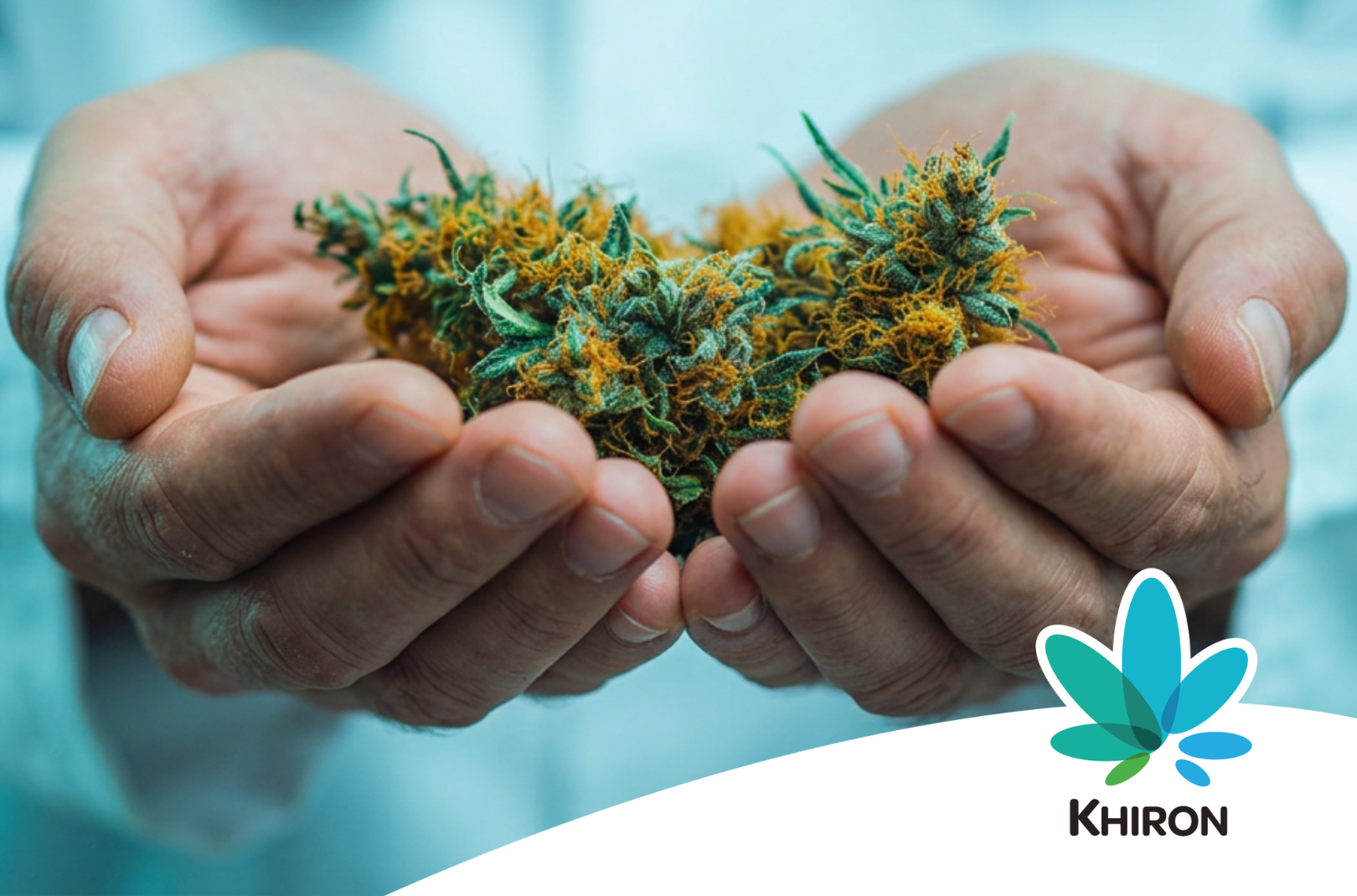
In common parlance, “regular cannabis” usually refers to cannabis intended for recreational use. Medical and regular cannabis often come from the same plant species and contain the same cannabinoids. The main differences lie in their intended use, quality requirements, traceable composition, and use under medical supervision.
Cannabis becomes a medicine through pharmaceutical controls, reliable product data, a doctor's prescription, and a treatment regimen with a verifiable treatment goal.
What is the difference between medical cannabis and regular cannabis?
Medical cannabis is used to treat conditions diagnosed by a doctor. It is available only by prescription, is tested according to pharmaceutical standards, and is dispensed through pharmacies.1 The product, dosage, and treatment goal are determined by a physician and reviewed throughout the course of treatment. The medical basis, active ingredients, and areas of application are explained in detail in the article “What Is Medical Cannabis?”
Regular cannabis, or recreational cannabis, is used for personal consumption. There is no medically defined treatment goal, nor is there any medical supervision of the dosage or effects.
Medical cannabis and recreational cannabis are regulated separately under the law: Medical cannabis is governed by the Medical Cannabis Act, while recreational cannabis is governed by the Recreational Cannabis Act.2 The Federal Ministry of Health summarizes the legal framework governing medical cannabis products and their prescription.
To make an objective comparison, three areas must be distinguished from one another:
- Medical cannabis is prescribed by a doctor, tested by pharmaceutical companies, and dispensed at pharmacies.
- In Germany, legal recreational cannabis, within the limits set by law, comes from private home cultivation or a noncommercial cultivation cooperative. It is not a medicine.
- Cannabis from the illegal market has no reliably traceable origin. Its active ingredient content, cultivation methods, processing, and potential contaminants usually remain unknown.
Accordingly, not all recreational cannabis comes from the illegal market. However, legal recreational cannabis does not automatically meet pharmaceutical standards.
An Overview of the Key Differences
| feature | Medical cannabis | Legal Recreational Cannabis | Cannabis from the illegal market |
| Purpose | Treatment of Specific Conditions | Personal Consumption | Personal Consumption |
| Access | Doctor's Prescription and Pharmacy | Home-grown produce or a farming cooperative within the legal framework | Illegal Acquisition |
| Quality Framework | Pharmaceutical Specifications and Documented Release | Legal requirements, but no pharmaceutical standard | No reliably verifiable guidelines |
| origin | Traceable Supply and Production Chain | Traceable depending on the form of purchase | Often Unknown |
| THC and CBD Content | Analyzed and specified for the product or batch | Partially with information, but without pharmaceutical batch release | Often unknown or unreliable |
| Dosage | Prescribed by a doctor and adjusted over time | Determined by the consumer | Determined by the consumer |
| Support | Medical Assessment of Benefits, Tolerability, and Risks | No regular medical care | No regular medical care |
| Treatment Goal | Concrete and verifiable improvement | No medically established treatment goal | No medically established treatment goal |
Note: The table describes different forms of supply and consumption. The impact of a single product cannot be determined from this information.
Does medical cannabis come from a different plant?
Both medical cannabis and cannabis for recreational use are typically derived from Cannabis sativa L. Both contain THC, CBD, other cannabinoids, and terpenes in varying concentrations.
The THC in a medical cannabis product is chemically no different from the THC in recreational cannabis. The body cannot tell for what legal purpose a plant was grown. It reacts to the active ingredients it contains, their quantity, the form of administration, and individual factors.
Are there specific medical cannabis strains?
There is no separate botanical category called “medicinal cannabis plant.” For medical cannabis, manufacturers select specific cultivars and grow them under controlled conditions. The goal is to meet defined product specifications and achieve the most reliable analytical values possible.
Strain names and broad classifications such as“Indica,” “Sativa,” and“Hybrid”do not provide a reliable indication of the medical effects. More meaningful factors include the analyzed cannabinoid content, the dosage form, the dose, and the individual’s response.
What does "pharmaceutical-grade" mean when it comes to cannabis?
Even when used as a medicine, cannabis remains a natural product. Plants and harvests are subject to natural variations. Pharmaceutical standards make these differences measurable and specify the limits within which a batch must fall.
What is tested in medical cannabis?
The relevant audit areas include:
- Identification and Classification of Plant Material
- THC, CBD, and Other Relevant Cannabinoid Content
- Occurrence and Content of Terpenes
- Microbiological Quality
- Foreign particles and moisture
- Contaminants such as heavy metals
- Product-Specific Arrears
- Packaging, Labeling, and Storage
For medical cannabis flowers, the European Pharmacopoeia contains a separate monograph setting forth requirements for identity, content, and purity. Additional information is published by the European Directorate for the Quality of Medicines & HealthCare.
A pharmaceutical test does not guarantee absolute freedom from every conceivable substance. It documents that a batch meets the specified specifications and limits.
Why is batch documentation important?
With medical cannabis, it is possible to trace which batch a patient received and what laboratory test results are available for it. This allows any observed effects or side effects to be specifically linked to a particular product. Pharmaceutical quality, therefore, does not attempt to completely standardize a natural plant. Instead, it translates its natural variability into measurable and controllable values.
Does medical cannabis contain different amounts of THC and CBD?
Medical cannabis does not automatically contain more or less THC or CBD than regular cannabis. The product range extends from THC-dominant and CBD-dominant formulations to those with more balanced active ingredient ratios. Extracts are also formulated to specific concentrations.
Why is it important to know the active ingredient content?
A medical assessment requires that the active ingredients and their concentrations be known. Only then can dosing, monitoring of progress, and subsequent adjustments be properly tracked. Percentage values for the active ingredients in a cannabis flower alone say little about the strength of the actual effect. Equally important are the amount used, the form of administration, and the individual’s absorption of the active ingredient. A high THC content therefore does not automatically equate to greater medical benefit.
Is there a difference in the effect?
Medical cannabis is often experienced differently because key factors are documented and monitored. Why?
- The product used is well known
- THC and CBD levels have been analyzed
- The dose is prescribed by a doctor
- The treatment is based on a treatment plan
- Assessment of Efficacy and Side Effects Over Time
When it comes to recreational use, dosage, expectations, and circumstances of use vary more widely. With cannabis of unknown origin, it is also unclear how much of the active ingredient is actually absorbed.
How does the form of administration affect the effect?
Inhaled cannabis (vaporizer) usually takes effect faster than orally administered cannabis extracts (dropper, spray, capsules, etc.). Orally administered products take longer to take effect, but the effects typically last significantly longer. Metabolism, tolerance, other medications, and individual sensitivity also influence the course of the effects. As a result, two patients may sometimes react differently even when using the same product.
Which cannabis products are used for medical purposes?
Cannabis flowers, extracts, compounded medications, and ready-to-use medications containing cannabinoids are available for medical treatment.3
Medical Cannabis Flowers
Cannabis flowers contain a mixture of plant-based active ingredients. For medical inhalation, they are typically heated using a suitable vaporizer. Smoking—for example, a joint—produces additional combustion byproducts, which is why this method is not recommended for medical use. The Federal Institute for Drugs and Medical Devices has published guidance on this topic.
Cannabis extracts and other medications
Extracts contain specific concentrations of THC and CBD and are taken orally. In addition, there are compounded medications as well as approved over-the-counter medications with a fixed composition.
What does this difference mean for patients?
No single dosage form is universally superior. The decisive factors are the treatment goal, the desired course of action, dosing flexibility, and individual tolerance.
Note: Coverage by health insurance
As of July 30, 2026, statutory health insurance will no longer cover cannabis flowers. For cannabis extracts of standardized quality, as well as medications containing dronabinol or nabilone, coverage remains possible under the statutory requirements. Prior to this, a six-month trial of therapy with an approved ready-to-use cannabis-based medication is generally required. Private prescriptions and treatment as a self-paying patient remain unaffected by this change.4
The treatment is guided by a verifiable goal
A medically sound cannabis therapy does not begin with the search for a specific strain, but rather with a specific treatment goal. Criteria for assessment include, for example, the frequency or intensity of certain symptoms, sleep quality, or daily functioning. Throughout the course of therapy, it is evaluated whether the desired benefits have actually been achieved.
Monitoring of Dosage and Tolerability
The appropriate dose varies from patient to patient. For this reason, medically supervised treatments often begin with a low dose, which is then adjusted based on the drug's effectiveness and tolerability.
Possible side effects include5:
- Fatigue and Dizziness
- Impairments in attention and reaction time
- Changes in Perception and Mood
- Dry mouth
- Circulatory problems
- Interactions with Other Medications
Personal risk depends on the product, the dose, existing medical conditions, and other medications.
Conclusion
The line between medical use and personal consumption is drawn where decisions become verifiable.
A reputable cannabis therapy has a clear treatment goal, a known product, a documented dose, and an agreed-upon time for evaluation. This framework does not guarantee treatment success. However, it does show whether the therapy provides a meaningful benefit in everyday life and whether side effects outweigh the potential benefits. Even a lack of success provides a solid basis for adjusting or discontinuing treatment.
Here are 4 questions to help guide you:
- What exactly is expected to improve as a result of the treatment?
- How can doctors and patients tell whether this goal has been achieved?
- What side effects or changes should be monitored?
- When will a decision be made regarding continuation, modification, or termination?
The medical benefit thus lies less in the plant's name than in the quality and traceability of therapeutic decisions.
FAQ
No. The body reacts to cannabinoids, the amount of active ingredient, the form of administration, and individual factors. The legal classification as a medicine or recreational cannabis does not alter the active ingredients.
Manufacturers select specific cultivars for medical cannabis products. These cultivars become medicines through controlled production, testing, documentation, prescription, and therapeutic use.
The difference lies not in a single ingredient, but in the medical context. This includes defined product specifications, analyzed active ingredient concentrations, batch documentation, medically prescribed dosages, and the monitoring of benefits and risks.
Not necessarily. Medical products have high, medium, or low THC levels, as well as varying CBD concentrations. The THC level alone does not determine either the medical benefit or the strength of the individual effect.
Cannabis-based medications containing THC have psychoactive effects and can sometimes induce a high. The intensity of this high depends on the dose, the form of administration, tolerance, and individual sensitivity.
Medical cannabis is tested against defined pharmaceutical specifications and limits. While this does not guarantee absolute purity, it does ensure traceable quality control.
The cost depends on the product, the prescribed quantity, and the pharmacy. With a private prescription, patients pay for the treatment themselves. With the entry into force of the Statutory Health Insurance Contribution Rate Stabilization Act, passed by the Bundestag on July 10, 2026, statutory health insurance reimbursement for cannabis flowers has been discontinued as of July 30, 2026. For standardized cannabis extracts as well as medications containing dronabinol or nabilone, a six-month trial period using an approved ready-to-use cannabis-based medication is initially required.
No. Medical cannabis in Germany is available only by prescription and is dispensed exclusively through pharmacies as a cannabis-based medication. This related article explains the two ways to obtain a prescription: Becoming a Cannabis Patient
Cannabis from a cultivation cooperative is legally classified as recreational cannabis and not a medication. It is not a substitute for a doctor's prescription or a pharmaceutically tested product from a pharmacy.
Only to a limited extent. With illegally traded cannabis, the origin, active ingredient content, storage conditions, and potential contaminants are often unknown. Legal recreational cannabis is subject to regulatory requirements, but this does not automatically mean it meets pharmaceutical-grade standards.
- Federal Ministry of Health: “Cannabis as Medicine” – Questions and Answers About the Law, section “What Are Cannabis Medicines?”. ↩︎
- Federal Ministry of Justice and Federal Office of Justice: Act on the Regulation of Recreational Cannabis (Recreational Cannabis Act—KCanG). ↩︎
- Federal Institute for Drugs and Medical Devices: FAQ on Medical Cannabis. ↩︎
- German Bundestag: Printed Paper 21/7016 – Recommendation for a Resolution and Report of the Committee on Health, particularly pp. 23–24; Federal Ministry of Health: Statutory Health Insurance Premium Rate Stabilization Act. ↩︎
- National Center for Complementary and Integrative Health, National Institutes of Health: Cannabis (Marijuana) and Cannabinoids: What You Need to Know. ↩︎