
Cannabis contains far more than just THC or CBD. The plant contains hundreds of bioactive compounds—including cannabinoids, terpenes, and flavonoids. It is precisely this interplay that gave rise to the term "entourage effect."
The basic idea: It is not individual compounds that determine the effects of a cannabis plant, but rather their combination. THC can be modulated by terpenes, and certain cannabinoids can influence one another or mitigate side effects. As a result, research on medical cannabis is increasingly focusing not only on isolated THC or CBD, but also on whole-plant extracts.n.
However, the term is often used in different ways. While some manufacturers present the entourage effect almost as an established fact, the scientific assessment is more cautious. In fact, there are interesting indications of synergistic effects—yet in many areas, there is a lack of robust clinical data.
The most important facts in brief
- The entourage effect describes the potential interactions between various compounds in cannabis.
- The focus is on cannabinoids, terpenes, and flavonoids.
- Whole-plant extracts may have different effects than isolated individual compounds.
- Some scientists criticize the term as being too vague or driven by marketing.
- The interaction between THC and terpenes is the subject of intensive research.
- Full-spectrum extracts are also currently a focus of cannabis research.
What does the "entourage effect" mean?
The entourage effect refers to the idea that cannabis compounds may have a different effect when taken together than when taken as isolated individual compounds. Rather than focusing solely on THC or CBD individually, research is increasingly examining the entire plant matrix. The term originated in the late 1990s in connection with research on cannabinoidsen. The original observation was that molecules that are biologically rather unremarkable may be able to influence the effects of other cannabinoids.
Today, the term "effect" is used in a much broader sense. It usually describes the interplay between:
- THC
- CBD
- Minor cannabinoids (such as CBG or CBN)
- Terpenes
- Flavonoids
The theory gained particular prominence through cannabis researcher Ethan Russo. In his frequently cited academic article “Taming THC,” Russo wrote as early as 20111:
“Terpenoids may increase cerebral blood flow, enhance cortical activity, kill respiratory pathogens, and provide anti-inflammatory activity.”
— Ethan B. Russo, British Journal of Pharmacology
Translated, that means:
“Terpenoids may increase cerebral blood flow, boost cortical activity, combat respiratory pathogens, and possess anti-inflammatory properties.” This demonstrates that the term is now interpreted much more broadly than it was just a few years ago. Not only cannabinoids themselves, but also the plant’s fragrances and flavor compounds may influence pharmacological effects.
How does the entourage effect work?
The exact mechanism of the entourage effect has not yet been fully elucidated. However, researchers believe that various pharmacological mechanisms may be involved.
Among other things, the following topics will be discussed:
- Interactions Between Cannabinoids
- Changes in Bioavailability
- Effects on Receptors
- Modulation by Terpenes
- Different signaling pathways in the nervous system
The recent review article “The Entourage Effect: Relevance and Controversies in Therapeutic Applications of Cannabis” describes precisely this complexity2. The authors write:
“The complexity of cannabis phytochemistry makes it difficult to attribute therapeutic effects to a single compound.”
— García-Gutiérrez et al., Biomedicines, 2025
Translated, that means:
"The complexity of cannabis phytochemistry makes it difficult to attribute therapeutic effects to a single active ingredient."
That is precisely why researchers are increasingly studying whole cannabis extracts rather than isolated individual compounds.
The Endocannabinoid System Explained Simply
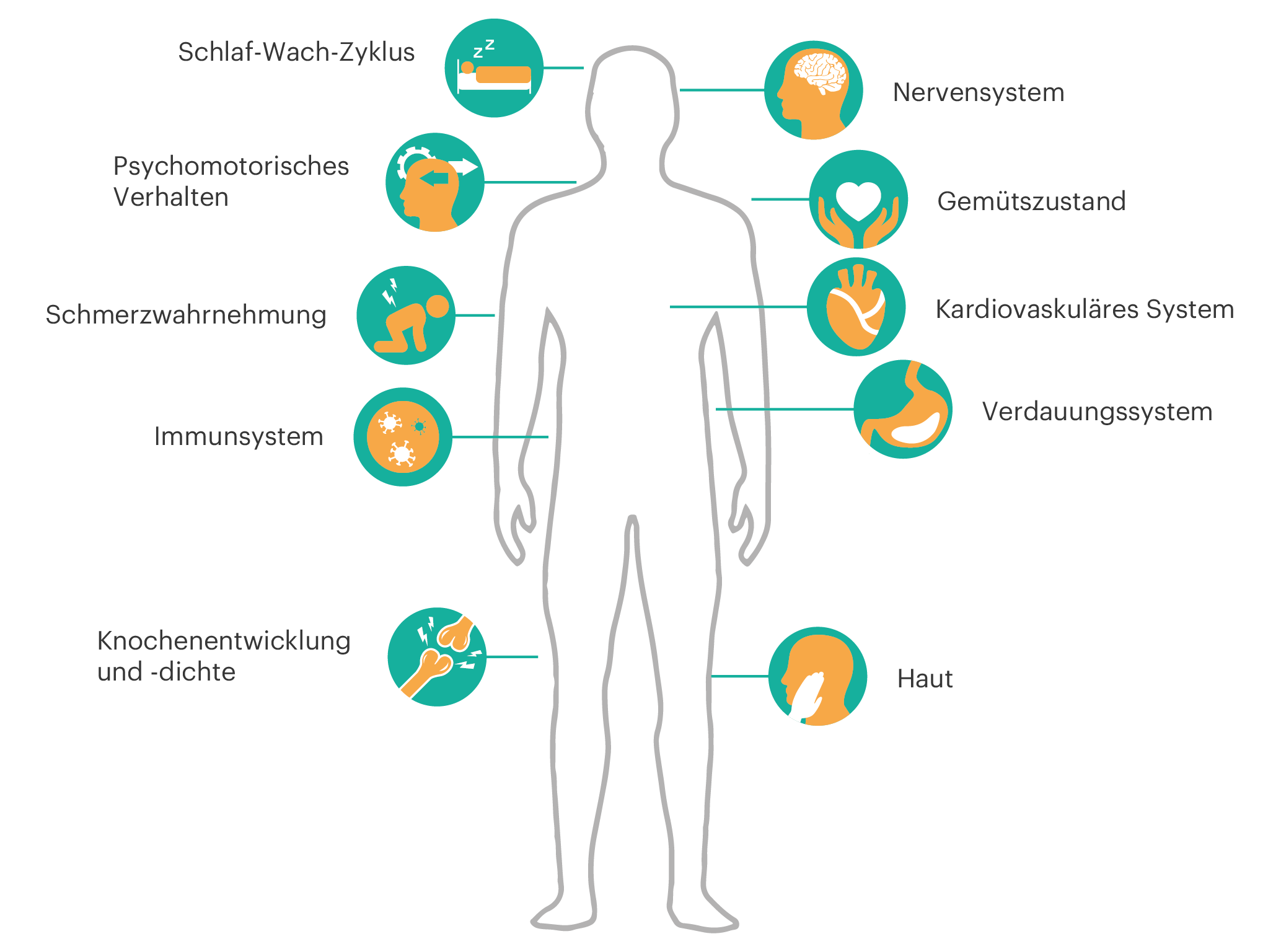
It is difficult to understand the entourage effect without knowing about the endocannabinoid system (ECS). This is the body’s own regulatory system, which is involved in numerous processes, including3:
- Sleep
- Mood
- Stress Responses
- Appetite
- Pain Management
- Immune Functions
The focus is on two receptors:
CB1 receptors
They are primarily located in the central nervous system. THC binds directly to these receptors, thereby causing psychoactive effects.
CB2 receptors
These receptors are more common in immune cells and peripheral tissues. Somen Cannabinoidsn Terpenes are believed to influence inflammation-related processes.
CBD behaves differently from THC. It does not bind directly to CB1 receptors, but rather influences various signaling pathways indirectly. This has led to the assumption that multiple cannabis compounds, when combined, can produce different or more complex effects than individual compounds in isolation.
What role do terpenes play in the entourage effect?
Terpenes are among the most exciting areas of research related to the entourage effect. Depending on the strain, they give cannabis different smells and flavors—ranging from earthy to spicy to fruity, citrusy, or gassy. For a long time, terpenes were considered primarily as fragrances. However, researchers are now also investigating their potential pharmacological properties.
Myrcene, for example, is also found in hops and mangoes. This terpene is often associated with calming properties. Limonene has a citrus-like aroma and is being studied in relation to mood and stress. Linalool is also known as a component of lavender. Research is exploring its potential relaxing effects. Caryophyllene is particularly interesting because it can bind directly to CB2 receptors—an unusual mechanism for a terpene4.
To date, research has primarily provided preclinical evidence of potential interactions between terpenes and cannabinoids. However, large-scale clinical trials in humans are still largely lacking.
For more information, click here: An Overview of the Most Important Cannabis Terpenes and Their Properties
THC, CBD, and Minor Cannabinoids: How They Interact
Public discussion often focuses on THC and CBD. In fact, however, cannabis contains far more cannabinoids.
These include, among other things:
- CBG
- CBC
- CBN
- THCV
Some of these compounds have pharmacological properties of their own. At the same time, it is believed that they may modulate or complement the effects of other cannabinoids. Medical cannabis is therefore being studied to determine whether whole-plant extracts might offer therapeutic advantages over isolated active ingredients. While CBD plays an important role in this context, it is not the sole focus of scientific research5. Many researchers are now increasingly interested in the interactions between different cannabinoids within the entire plant matrix.
Full Spectrum, Broad Spectrum, or Isolate?
The entourage effect is frequently discussed in connection with full-spectrum cannabis extracts. The reason: These products contain not only individual cannabinoids, but as many of the hemp plant’s natural compounds as possible. The more closely an extract preserves the plant’s original composition, the more often people talk about potential synergistic effects.
Full Spectrum
Full-spectrum extracts contain a wide range of natural plant compounds, including:
- Cannabinoids such as THC, CBD, CBG, or CBN
- terpenes
- Flavonoids
- Other Secondary Plant Compounds
A typical example of a full-spectrum cannabis extract is Khiriox 12/14 from KHIRON. Unlike isolated active ingredients, the natural plant matrix is largely preserved in this product. This is precisely where proponents of the entourage effect see a potential benefit: the various compounds in the hemp plant may influence or complement one another.
Broad Spectrum
Broad-spectrum products are similar to full-spectrum extracts but generally do not contain detectable levels of THC. This preserves many of the plant compounds found in the hemp plant while avoiding psychoactive effects. Such extracts often also contain:
- CBD
- Minor Cannabinoids
- terpenes
- Flavonoids
Broad-spectrum products are often preferred by people who want to avoid THC but don't want to completely forgo the other plant compounds.
Isolates
In isolates, a single active ingredient—as the name suggests—is specifically isolated: usually CBD. This results in a highly pure product without significant amounts of other plant compounds from the hemp plant. Terpenes, flavonoids, and additional cannabinoids are largely removed during production. Isolates allow for very precise dosing of individual active ingredients. At the same time, they lack the plant compounds that are often associated with the entourage effect.
This is precisely why researchers are asking whether isolated cannabinoids and whole-plant extracts might have different pharmacological properties. Proponents of the entourage effect argue that full-spectrum extracts better preserve the plant’s natural composition. Critics counter that many of the claimed benefits have not yet been sufficiently proven in clinical studies.
What does the research really say?
Research on the entourage effect provides interesting insights, but so far no conclusive evidence. Neurologist and cannabis researcher Ethan Russo is considered one of the best-known proponents of the entourage theory. In his 2011 research article “Taming THC,” Russo described possible synergistic effects between cannabinoids and terpenes. Among other compounds, he cited caryophyllene, linalool, and myrcene as pharmacologically relevant plant compounds.
More recent studies have also addressed this topic. A review article by García-Gutiérrez et al. published in 2025 in the journal *Biomedicines* analyzed current studies on cannabis extracts, cannabinoids, and terpenes. The authors conclude6:
“The entourage effect remains an attractive hypothesis, but the current evidence is still insufficient to support broad therapeutic claims.”
Translated: “The entourage effect remains an attractive hypothesis, but the current evidence is not yet sufficient to draw far-reaching therapeutic conclusions.”
In fact, much of the data to date comes from cell studies, animal models, or small-scale studies. Large-scale clinical trials in humans are still lacking. Furthermore, cannabis is chemically extremely complex: the strain, terpene profile, extraction method, and cannabinoid composition can vary significantly, which makes it difficult to compare studies. The current state of research can therefore best be summarized as follows: The entourage effect is considered scientifically plausible but has not yet been conclusively proven.
Why the Entourage Effect Remains Controversial
Today, the entourage effect is referred to simultaneously as:
- Research Model
- Therapeutic Hypothesis
- Marketing term
is used. This is precisely where part of the controversy lies. Even manufacturers and sellers of cannabis products often use the term in a very general way, even though scientific research presents a much more nuanced argument. Not every combination of plant compounds automatically produces synergies. It is even possible that some substances may actually counteract each other.
In addition, cannabis products vary widely:
- Varieties
- Terpene Profiles
- Extraction Methods
- Cannabinoid concentrations
- Purity
differ, in some cases significantly. This makes it difficult to make general statements about the entourage effect.
Conclusion
The entourage effect describes the possibility that cannabis compounds have a different effect when acting together than when they are isolated. Current research is focusing in particular on the interaction between cannabinoids and terpenes.
The theory is considered scientifically plausible, but the data remain complex. Preclinical studies provide interesting evidence of synergistic effects, but large-scale clinical trials are still lacking for many therapeutic claims.
That is precisely why the entourage effect is emerging as one of the most exciting areas of research related to cannabis, full-spectrum extracts, and cannabinoid pharmacology.
FAQ on the Entourage Effect
The entourage effect describes the idea that cannabis compounds may have a different effect when taken together than when taken as isolated individual compounds, such as THC or CBD alone.
Terpenes may influence cannabinoids or have their own biological effects. Researchers are currently investigating just how strong these interactions actually are.
Not entirely. There is preclinical evidence and pharmacological models, but so far there have been no clinical trials in humans.
Full-spectrum products contain various plant compounds from the cannabis plant, while isolates contain only a single active ingredient, such as CBD.
Because the term is often used in a very general way. From a scientific perspective, it likely refers to various pharmacological interactions rather than a single, clearly defined mechanism.
- Russo EB. Taming THC: Potential Cannabis Synergy and Phytocannabinoid-Terpenoid Entourage Effects. British Journal of Pharmacology. 2011;163(7):1344–1364. ↩︎
- García-Gutiérrez MS et al. The Entourage Effect: Relevance and Controversies in Therapeutic Applications of Cannabis. Biomedicines. 2025. ↩︎
- Lu HC, Mackie K. An Introduction to the Endogenous Cannabinoid System. Biological Psychiatry. 2016;79(7):516–525. ↩︎
- Gertsch J et al. Beta-caryophyllene is a dietary cannabinoid. Proceedings of the National Academy of Sciences (PNAS). 2008;105(26):9099–9104. ↩︎
- Russo, E.B. “The Case for the Entourage Effect and Conventional Breeding of Clinical Cannabis.” Frontiers in Plant Science. 2019. ↩︎
- García-Gutiérrez MS et al. The Entourage Effect: Relevance and Controversies in Therapeutic Applications of Cannabis. Biomedicines. 2025. ↩︎